Imagine Nature's Wheelwork
Think As Nature Intended
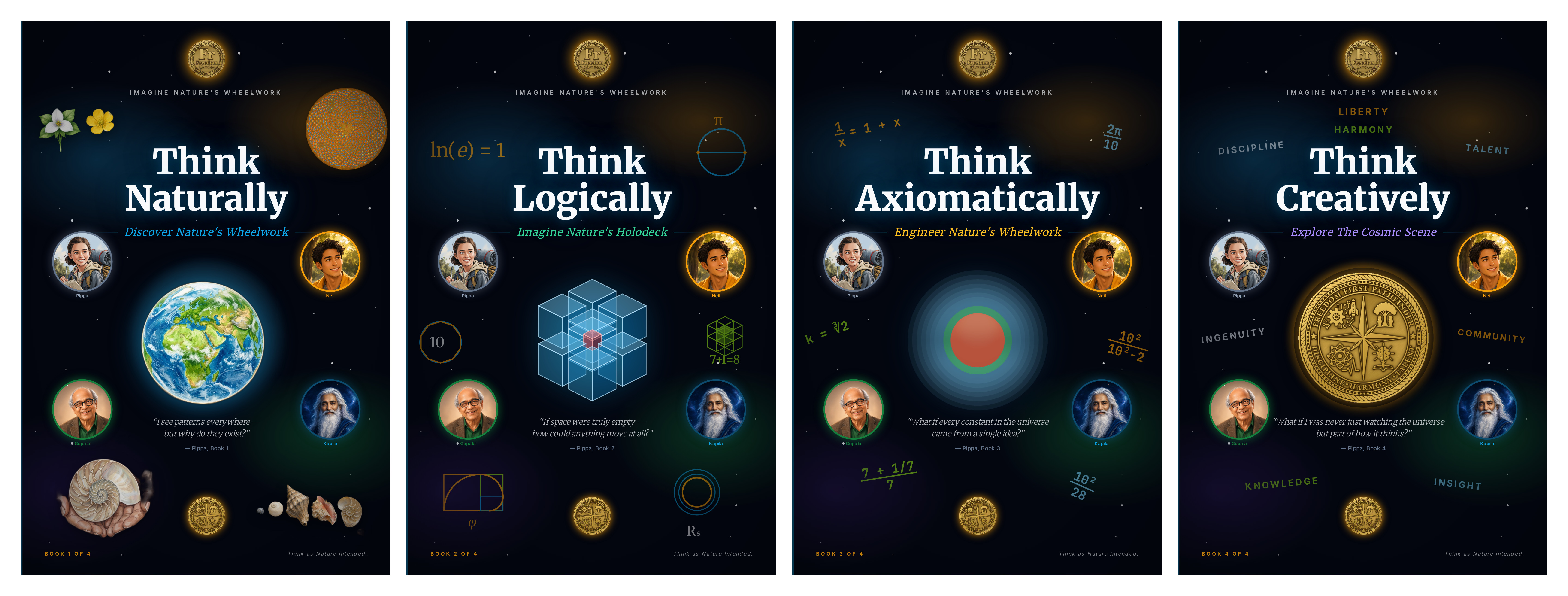
Imagine Nature's Wheelwork is a four-book young adult series that guides readers through a structured progression of scientific thinking — from natural observation to logical deduction, axiomatic derivation, and creative application. Each book advances a single cohesive question: How does nature actually work, and how can we derive that from first principles? The series draws exclusively from G. Srinivasan's transliteration of Maharishi Kapila's ancient Sankhyakarika — a closed axiomatic system capable of deriving measurable physical constants without prior assumptions.
Target Audience: Ages 13–18+ (Young Adult), with particular relevance for STEM learners seeking coherent, derivable explanations over rote memorisation. Suitable for homeschool, gifted programmes, science clubs, and independent young readers. Adult readers with science backgrounds will find equal depth.
Value Proposition: The only science education series built on a fully derivable axiomatic framework — where every constant, every pattern, and every principle is shown to follow from a single consistent source. Readers do not memorise facts; they derive them.
The Imagine Nature's Wheelwork website has more information, activities, simulations and teaching support regarding the INW Knowledge Commons.

Derivation, not memorisation — every result is reached through a logical chain the reader can follow and verify
Single coherent source — the entire series builds from one axiomatic framework rather than patchworking modern physics models
Bridges Eastern and Western science — ancient Sankhya sutras verified against modern measured constants
Ethics integrated, not appended — Sanatana Dharma principles are woven into each book's narrative and decision-making, not added as a moral epilogue
Progressive thinking framework — each book develops a distinct cognitive mode, building the reader's full scientific toolkit
Built-in reader activities — every chapter includes structured discovery exercises, online interactive tools, and reflection prompts that reinforce independent learning and self-discovery rather than passive reading
Culminates in self-knowledge — the series ends not with an exam but with Kaivalya: the student as co-creator
Discover Nature's Wheelwork (first release coming soon)
Pippa observes that nature encodes consistent mathematical patterns — Fibonacci sequences, the golden ratio, and self-similar structures — in every living and non-living system. Guided by Neil and Gopala, she learns that observation is the first scientific instrument.
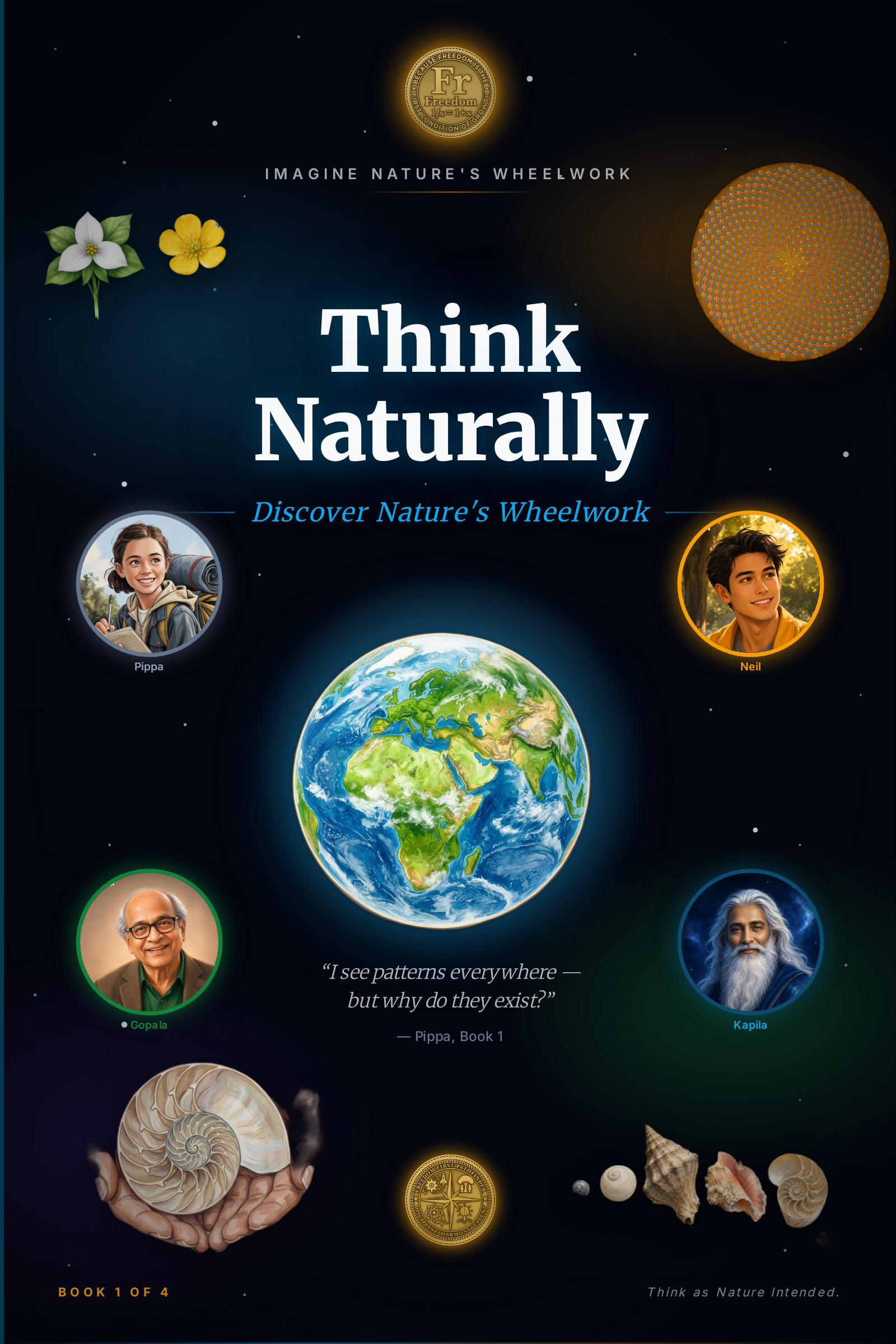
Think Naturally is the opening volume of Imagine Nature's Wheelwork, a four-book young-adult series that teaches science the way nature actually builds it — from first principles. Curious and notebook in hand, teen investigator Pippa keeps noticing the same shapes everywhere: the spiral of a sunflower head, the branching of a tree, the curl of a wave, the proportions of her own hand. With her mentor Neil she discovers these are not coincidences but signatures of a single underlying pattern-maker — Fibonacci sequences, the golden ratio, and self-similar structure repeating from the very small to the very large.
Rather than asking readers to memorize facts, this book trains them to observe, question and reason. Every chapter turns wonder into method: Pippa learns that observation is the first scientific instrument, and that behind every pattern lies a cause waiting to be derived. The mathematics is introduced gently and visually, always tied to something real the reader can find outside their own window.
Grounded exclusively in G. Srinivasan's transliteration of Maharishi Kapila's ancient Sankhyakarika, the series bridges Eastern and Western thought without mysticism, treating the Sankhya framework as a coherent, testable natural science. Each chapter ends with 'Explore It Yourself' activities and links to free interactive tools so readers build the pattern-finding habit for themselves.
Written for ages 13–18+ and ideal for homeschool, gifted programs and independent STEM readers, Think Naturally sets Pippa — and the reader — on a path that will lead, book by book, from seeing patterns to deriving the laws of the universe.
Imagine Nature's Holodeck
Through logical deduction, Pippa proves that space cannot be empty — it must be a filled continuum with specific dynamic properties. She derives the six key numbers (7, 10, e, π, x, Rs) and the Balance Equation, identifying the Perpetual Harmonic Oscillator (PHO) as Nature's holographic substratum.
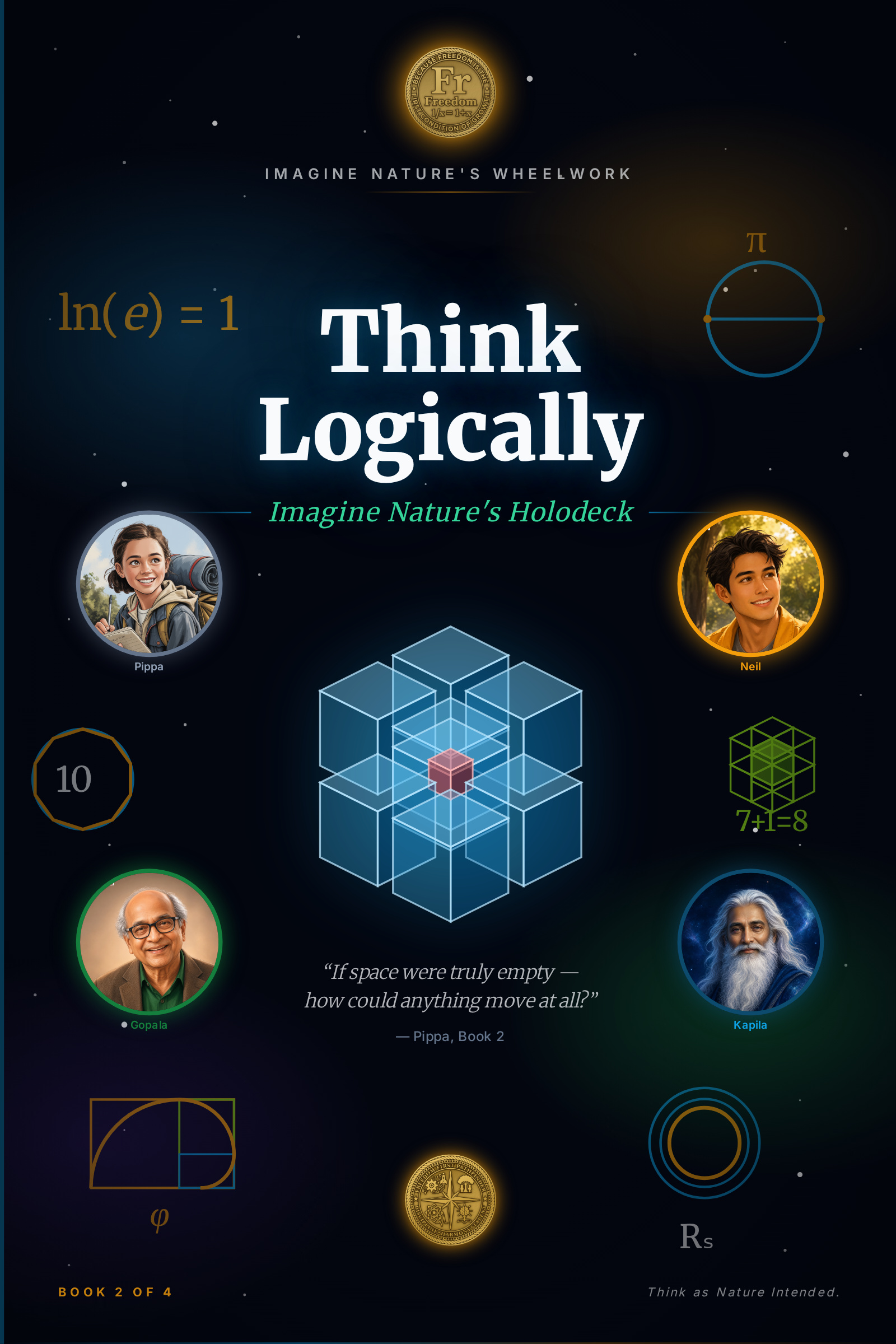
In Think Logically, the second book of Imagine Nature's Wheelwork, Pippa moves from observing nature's patterns to proving why they must exist. The driving question is deceptively simple: if space were truly empty, how could anything move, vibrate or hold together at all? Guided by Gopala and Neil, Pippa follows a chain of logical deductions to a startling conclusion — space cannot be empty. It must be a filled, dynamic continuum with specific, measurable properties.
Step by step, and without asking the reader to take anything on faith, she derives the six key numbers that define this substratum (7, 10, e, π, x and Rs) and assembles them into the Balance Equation. From these follows the Perpetual Harmonic Oscillator, or PHO — the holographic 'stage' on which every physical phenomenon plays out. What began as a thought experiment becomes a rigorous, self-consistent model of reality.
Think Logically develops the reader's second cognitive tool — deductive reasoning — building directly on the observational skills from Book 1. The logic is presented as a story the reader can follow and check, with clear diagrams and worked steps rather than assertions. Every chapter includes 'Explore It Yourself' discovery exercises and online tools that let readers test the reasoning for themselves.
Drawn entirely from G. Srinivasan's transliteration of Kapila's Sankhyakarika, the series treats this ancient axiomatic system as authentic natural science, verified against modern measured values. Written for ages 13–18+ and suited to homeschool, science clubs and independent young thinkers, this volume proves the stage exists — and sets up the derivations to come.
Engineer Nature's Wheelwork
Working through Kapila's 68 axiomatic Sutras, Pippa derives c as Nature's timeclock (296,575,966 osc/cycle), reframes gravity as a missing interactive count, and maps the full ladder of phenomena from subatomic scale to cosmic scale. Physical constants emerge as consequences, not inputs.
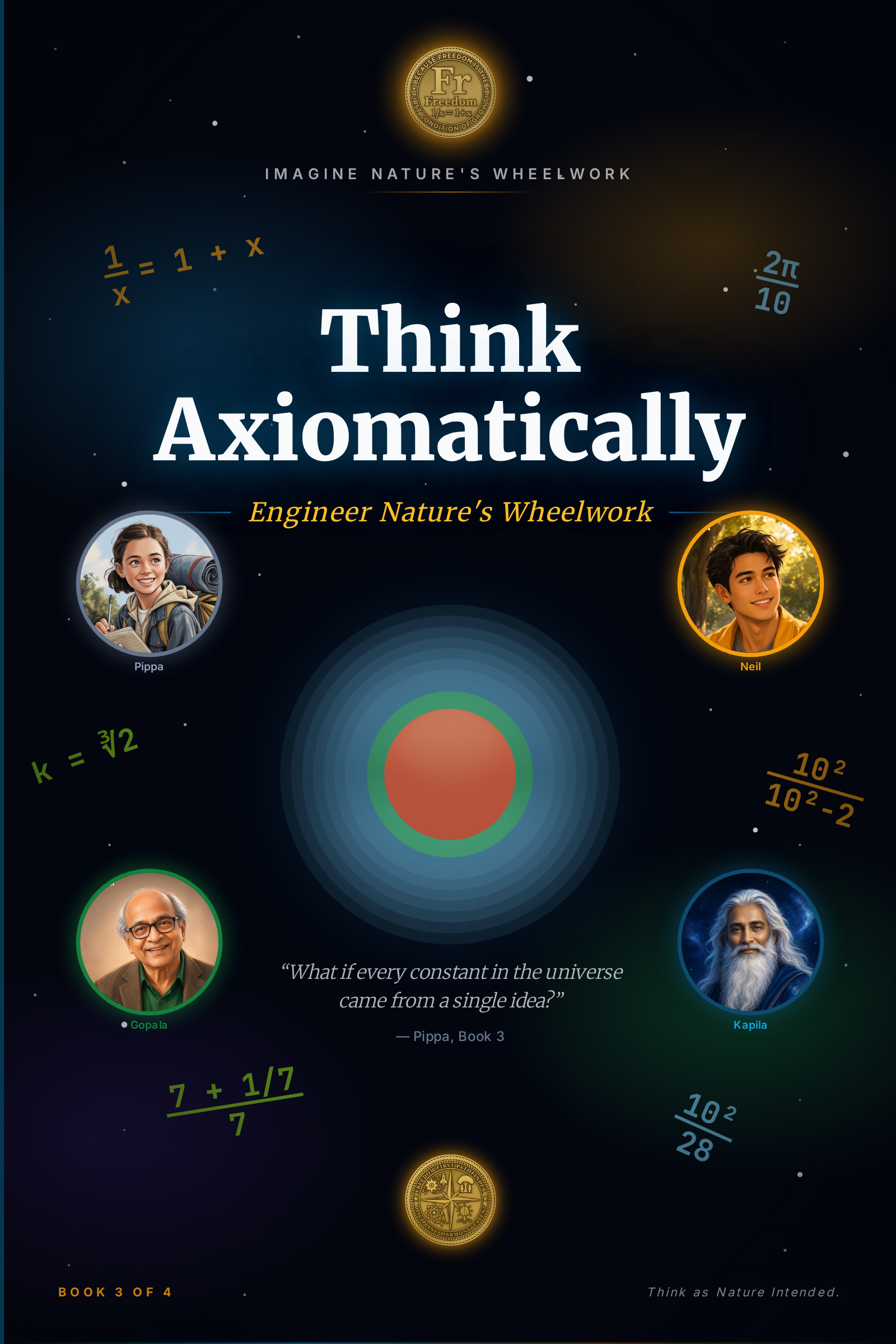
Think Axiomatically is the third book of Imagine Nature's Wheelwork, and the point where the series turns from reasoning to engineering. Having proved that nature runs on a filled, oscillating substratum, Pippa now works directly through Kapila's 68 axiomatic Sutras to derive the constants of physics as consequences rather than inputs. With Gopala and Neil she reaches one of the framework's boldest results: the speed of light emerges as nature's own timeclock — 296,575,966 oscillations per cycle — and gravity is reframed not as a mysterious pulling force but as a 'missing interactive count.'
From there she maps the full ladder of phenomena, from the subatomic scale to the cosmic scale, showing how a single consistent set of axioms accounts for structures at every level. The reader learns the third thinking mode — axiomatic derivation — discovering how much of what is usually memorized as separate 'laws' can instead be built from one foundation.
True to the series method, nothing is asserted without a derivable chain the reader can follow. Each chapter pairs its physics with 'Explore It Yourself' activities and free online calculators so readers can reproduce the key results and feel the difference between believing a constant and deriving it.
All scientific content is drawn exclusively from G. Srinivasan's transliteration of Maharishi Kapila's Sankhyakarika, presented as coherent, self-verifying natural science rather than mythology. Written for ages 13–18+ and ideal for advanced STEM learners, homeschoolers and curious adults, Think Axiomatically hands the reader a working toolkit — and asks the next question: now that you can derive the constants, how will you apply them?
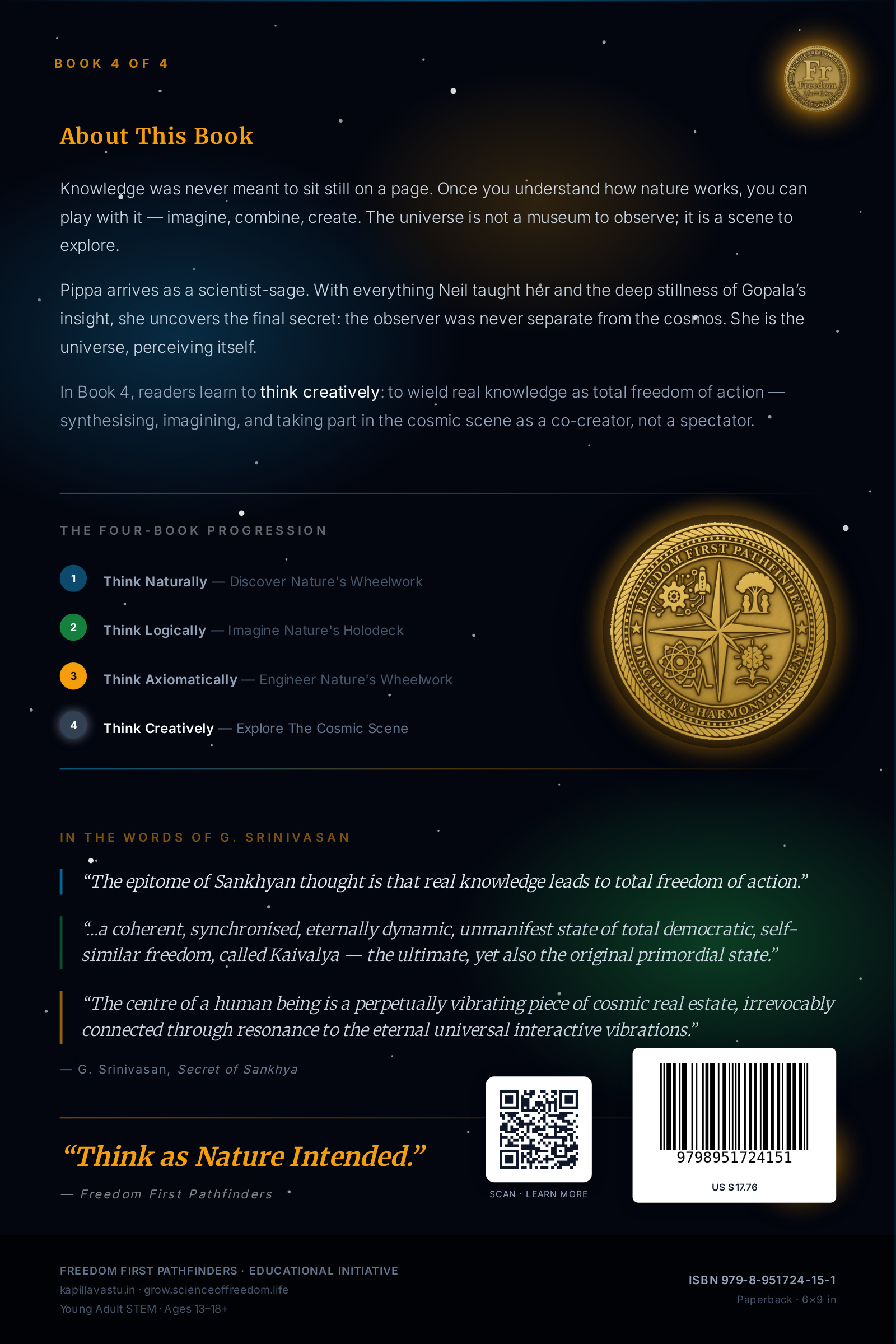
Explore The Cosmic Scene
Pippa applies the complete PHO framework across chemistry, biology, music, and astro-dynamics, then turns inward — understanding consciousness itself as substratum expansion. The series culminates in Kaivalya: the recognition that the self is the axiomatic power center of the universe.
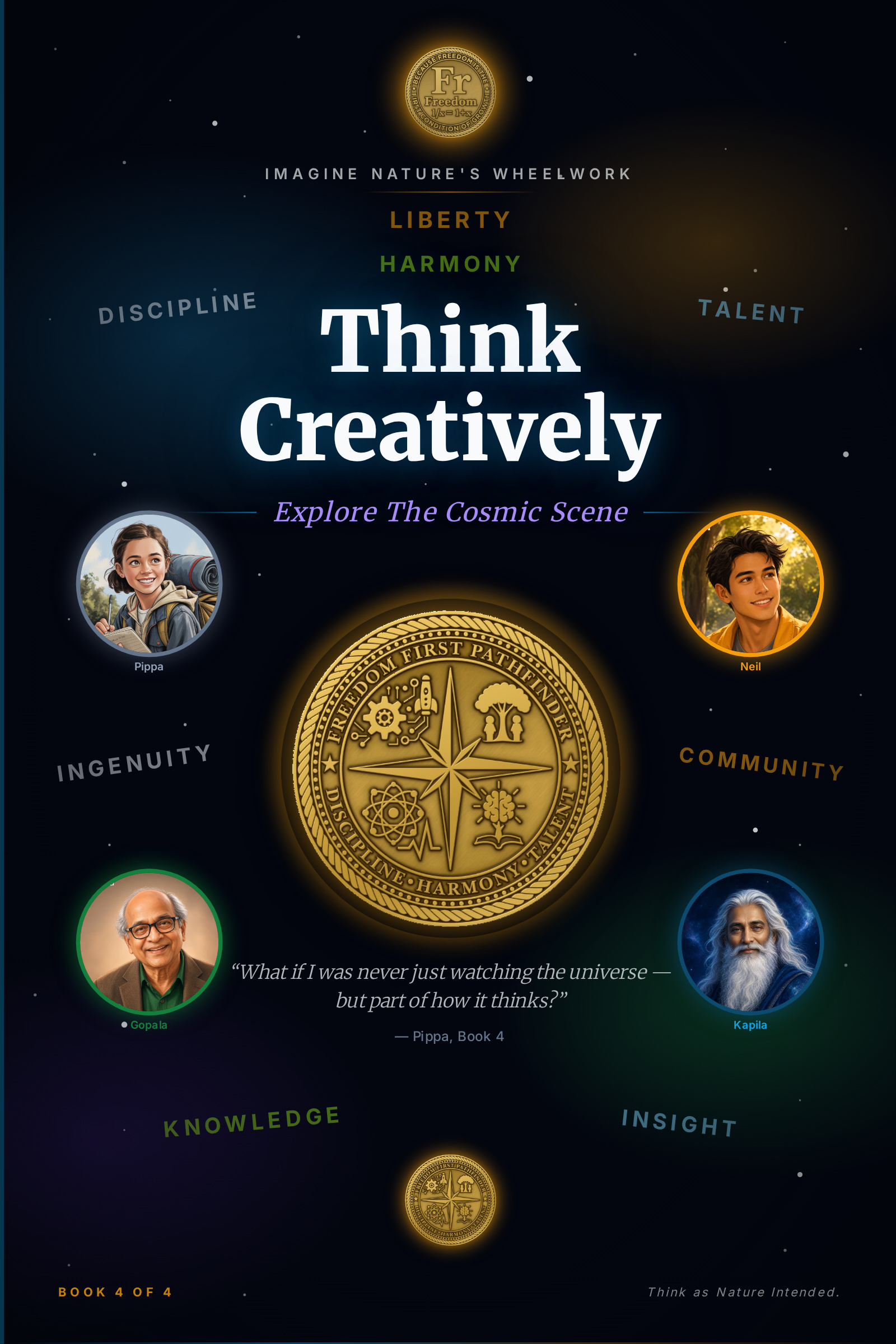
Think Creatively is the culminating volume of Imagine Nature's Wheelwork. With the full Perpetual Harmonic Oscillator framework in hand, Pippa — now joined by both Neil and Gopala — applies it across an astonishing range of fields: chemistry, biology, music and astro-dynamics, watching the same axioms that derived the speed of light also explain molecular structure, living form, harmony and the motion of the cosmos.
Then the series makes its final, most daring turn: inward. Pippa examines consciousness itself as a form of substratum expansion, and arrives at Kaivalya — the recognition that the observer is not separate from what is observed, but is the axiomatic power center through which the universe perceives and creates. The reader's fourth thinking mode, creative application, completes the cognitive toolkit the series has been building since Book 1.
This volume shows science as generative, not merely descriptive: once you can derive the rules, you can compose with them. Ethics is woven throughout — Sanatana Dharma principles are part of the reasoning and decision-making, not appended as a moral epilogue. Each chapter carries 'Explore It Yourself' projects and interactive tools that invite readers to synthesize, create and reflect.
Grounded entirely in G. Srinivasan's transliteration of Kapila's Sankhyakarika, the series ends not with an exam but with an invitation: the student as co-creator. Written for ages 13–18+ and suited to homeschool, philosophy-of-science discussion and independent readers, Think Creatively closes Pippa's journey — and opens the reader's, with the question that started it all now turned around: I am the universe perceiving itself. What will I create?