
A Golden Age That Will Last
Build Differently - Create A Better Golden Age
Freedom-Centered Civilizational Transformation
Executive Summary
Context: Science: A New Golden Age and the Genesis Mission and the need for an alternative path
UPDATE: The Is Sankhya the Acme of Gold Standard Science? A Multi-AI Validation Report was generated in response to the OSTP initiative Science: A New Golden Age report. It is an in-depth look at how the frontier AI models view Sankhya (negatively) but in so doing may be guilty of violating the very Gold Standard Science protocols they advocate for. The report invites OSTP and other interested parties to validate the readily verifiable Sankhya science and to share their independent findings openly.
The Genesis Mission operates under restricted access requiring “the highest standards of vetting and authorization,” with participation conditional on security clearances. This continuation of the post-WWII classification paradigm, while understandable for certain national security applications, creates barriers to broader scientific participation and raises questions about accountability when AI-directed systems make decisions.
Similarly, the Frontier Institute’s “Golden Age” 10-year plan institutionalizes the centralized technocratic control at the expense of freedom-preserving innovation. Others with substantial resources have similar 10-year technology investment plans. While the Frontier Institute’s approach seeks to restore American technological leadership through government-industry partnerships and strategic competition with China, the proposed alternative strategy -- based on ancient knowledge and wisdom both the Genesis Mission and Frontier Institute fail to recognize -- empowers individuals and communities through open access to foundational scientific knowledge and wisdom while building decentralized technological infrastructure that restores the balance of power in favor of the people for whom government serves.
This report presents the Freedom First Pathfinders (FFP) approach—not in opposition to federal efforts like the Genesis Mission, but as a parallel track that ensures the benefits of advanced science remain accessible to all mankind. Both approaches can and should coexist: the Genesis Mission for secured federal research in sensitive domains, and the FFP approach for open civilian research that accelerates human flourishing through decentralized, freedom-preserving innovation.
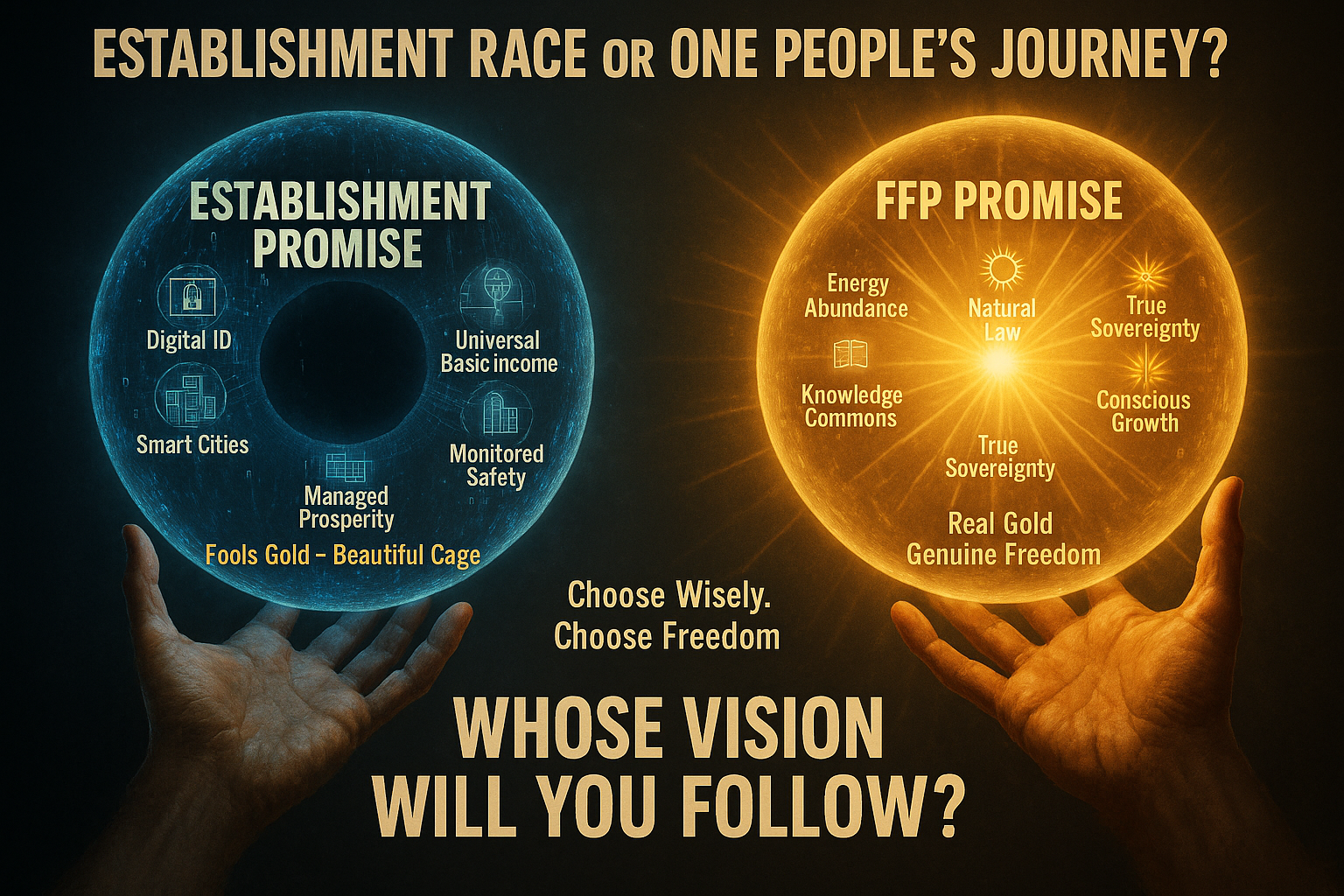
The Core Strategic Divergence
The Frontier Institute’s model operates within familiar parameters: venture capital partnerships, government procurement, regulatory reform, and intellectual property protection. More concerningly, recent establishment thinking—exemplified by the Council on Foreign Relations’ November 2025 “Economic Security” report—recommends that the United States essentially copy China’s state-directed model, matching their $900 billion technology spending with $15-20 billion in targeted U.S. government subsidies, export controls, and investment restrictions. Both approaches, while potentially effective in securing short-term advantages, risk accelerating the very centralization of power and erosion of individual freedom that many Americans fear.
The alternative strategy proposed herein is built on four foundational pillars:
- Sankhya Physics as Unified Scientific Foundation - Mainstreaming an ancient, axiomatic unified field theory that demonstrably derives fundamental physical constants from first principles (Planck’s constant, speed of light, gravitational constant, particle masses—matching experimental values to 4-8 significant figures), enabling breakthrough applications while democratizing access to “root-level” understanding of nature’s laws
- Decentralized Implementation Architecture - Replacing centralized government-corporate partnerships with self-organizing, self-governing cooperative networks that distribute both knowledge and productive capacity
- Freedom Preservation as Design Principle - Making individual liberty and power decentralization non-negotiable constraints on all technological development, not afterthoughts
- Conscious Technology Co-Evolution - Prioritizing consciousness development (education, mindset, values) alongside technological capability through proven pedagogical frameworks that can teach quantum unified field theory to learners as young as 13 years old
Key Strategic Recommendations
Scientific Foundation: Invest $500M over 5 years in rigorous validation and mainstream integration of Sankhya physics through partnerships with leading research institutions (e.g. UT Austin Texas Quantum Institute, NVIDIA Quantum Research Center). Recent analysis demonstrates that Sankhya’s axiomatic derivation of physical constants cannot be dismissed as arbitrary or coincidence — the systematic derivation from 1+1=2 to precise predictions matching experimental measurements (h = 6.6701x10⁻³^4 J·s vs. measured 6.626x10⁻³^4, 99.3% agreement; alpha-1 = 137.04 vs. measured 137.036, 99.99% agreement) provides strong quantitative validation. This creates an alternative to proprietary, black-box technological development by grounding breakthrough applications in openly accessible first principles.
Organizational Innovation: Establish a network of 508(c)(1)(A) (federally recognized, administrative state policy exempt, faith based) organizations; decentralized cooperatives grounded in the “laws of nature and of nature’s God” as stated in Declaration of Independence and embodied in the world’s oldest and continuously practiced belief system Sanatana Dharma, immune to capture by special interests—avoiding the rent-seeking and regulatory capture inevitable in subsidy-based approaches.
Education Before Technology: Launch a comprehensive “Science of Freedom” curriculum reaching 1,000+ educational institutions within 5 years, ensuring that consciousness and understanding precede technological deployment. Detailed pedagogical analysis demonstrates feasibility through a six-module progressive curriculum with interactive learning technologies (Space Voxel Simulator, Axiomatic Derivation Engine, Particle Builder Laboratory) achieving target metrics of 80% completion rate (vs. 45% industry average), 90% knowledge retention (vs. 20% traditional methods), and 40% improvement in problem-solving speed. Market validation shows 1.5 billion potential learners globally seeking culturally-rooted STEM education, with $600M+ annual revenue potential demonstrating commercial sustainability.
Dual-Track Validation: Simultaneously pursue grassroots community building (targeting 100,000+ active participants) and leading scientific validation (peer-reviewed publications, working prototypes) to create unstoppable momentum from both bottom-up and top-down directions.
Technology Applications: Focus initial efforts on seven high-impact domains with total addressable market exceeding $400B: advanced materials, energy production, propulsion systems, water technology, life sciences (health and food), and computational methods—all implemented through open licensing and decentralized manufacturing.
Expected Outcomes (10-Year Horizon)
- Scientific Validation: Peer-reviewed confirmation of Sankhya principles; demonstration of 50-90% computational efficiency gains in quantum simulations; first commercial applications of Sankhya-enabled technologies
- Community Transformation: 100,000+ individuals actively engaged in decentralized technology cooperatives; 1,000+ educational institutions integrating Science of Freedom curriculum; 20+ countries with active networks
- Economic Impact: $50-100B in market value created through advanced materials; $30-70B through energy innovations; $100-200B through accelerated pharmaceutical development—all distributed through decentralized ownership structures
- Freedom Preservation: Measurable reduction in technological power concentration; growth in individual energy/computing self-sufficiency; expansion of decentralized alternatives to dominant platforms
- Civilizational Metrics: 10x improvement in Civilization Power Index (Energy Abundance x Applied Intelligence x Ingenuity Mindset) through balanced advancement across all three dimensions
The Choice Before Us
The Genesis Mission, Frontier Institute and Council on Foreign Relations offer paths to winning the 21st-century technological competition through familiar institutions and power structures—whether venture capital partnerships or government subsidies matching China’s $900 billion spending. This alternative offers something more profound: a transformation in the nature of technological development itself—from proprietary to open, from centralized to distributed, from technocratic control to individual empowerment, from subsidy competition to breakthrough physics, from capability without wisdom to conscious evolution.
The choice is not between American competitiveness and foreign dominance. It’s between perpetuating a centralized paradigm or pioneering a genuinely different path grounded in freedom, decentralization, and breakthrough science that makes current technological limitations obsolete.
The question is not whether America can lead in technological innovation—it is what kind of future we are innovating toward. This report presents a roadmap for achieving a true Golden Age: one where technological abundance serves mankind’s flourishing and freedom rather than concentrating power in the hands of a technological elite or worse, where breakthrough physics enables capabilities impossible under current paradigms, and where ancient wisdom validated through rigorous science democratizes access to nature’s fundamental laws.
Table of Contents
1. Introduction
1.1 Context and Purpose
1.2 Scope and Methodology
1.3 Report Structure
2. Analysis of Current Approaches
2.1 The Frontier Institute’s Golden Age Plan: A Critical Assessment
2.2 The Technocratic Trap: Why Conventional Approaches Fall Short
2.3 Lessons from Recent Technological Development
2.4 The Case for Radical Alternatives
2.5 The Centralized Control Fallacy: Contrasting the CFR “Economic Security” Approach
2.6 The Genesis Mission: Centralized AI for Science (November 2025)
3. Alignment with Amir Husain’s Vision
3.1 The Cybernetic Society and Human-Machine Synthesis
3.2 Where This Strategy Extends Husain’s Vision
3.3 Husain’s Warning About Hyperwar
3.4 Integration Summary
4. The Alternative Strategy Framework
4.1 Philosophical Foundations: The Science of Freedom
4.2 Scientific Foundation: Sankhya Physics as Unified Theory
4.3 Decentralized Implementation Architecture
4.4 Freedom-Preserving Technology Design Principles
4.5 Integration of Ancient Wisdom with Modern Technology
5. Technological Applications
5.1 Overview of Seven Key Domains
5.2 Advanced Materials
5.3 Energy Production
5.4 Life Sciences - Health
5.5 Life Sciences - Food Production
5.6 Propulsion Technology
5.7 Water Technology
5.8 Computational Methods
6. Implementation Roadmap
6.1 Phased Approach Overview
6.2 Phase 1: Foundation (Years 1-2)
6.3 Phase 2: Validation (Years 2-4)
6.4 Phase 3: Scaling (Years 4-7)
6.5 Phase 4: Transformation (Years 7-10)
7. Economic and Social Impact
7.1 Market Opportunity Analysis
7.2 Job Creation and Economic Empowerment
7.3 Wealth Distribution and Inequality Reduction
7.4 Social Cohesion and Community Resilience
7.5 Freedom Preservation Metrics
7.6 Environmental and Sustainability Impacts
7.7 Health and Well-Being Impacts
7.8 Education and Human Development
7.9 Geopolitical and International Development
7.10 Comparative Analysis: Alternative Strategy vs. Frontier Institute
8. Risks, Challenges, and Mitigation Strategies
8.1 Scientific Validation Risks
Risk: Sankhya Claims Prove Invalid
Risk: Mainstream Science Rejects Approach
Risk: Computational Efficiency Gains Don’t Materialize
8.2 Organizational and Governance Risks
Risk: Network Fragments or Loses Coherence
Risk: Cooperatives Fail Economically
Risk: Capture by Bad Actors
8.3 Competitive and Market Risks
Risk: Incumbent Firms Block Market Entry
Risk: Technologies Don’t Achieve Cost Competitiveness
Risk: Faster Competitive Innovation
8.4 Political and Regulatory Risks
Risk: Regulatory Barriers
Risk: Geopolitical Backlash
8.5 Funding and Financial Risks
Risk: Insufficient Philanthropic Funding
Risk: Commercial Model Doesn’t Generate Sufficient Revenue
8.6 Social and Cultural Risks
Risk: Insufficient Public Understanding/Acceptance
Risk: Labeled as Anti-Science or Pseudoscience
Risk: Coopted by New Age Movement or Dismissed as Such
8.7 Existential and Ethical Risks
Risk: Accelerating Capability Without Sufficient Wisdom
Risk: Technologies Enable New Forms of Oppression
Risk: Creating New Dependencies
9. Conclusion and Call to Action
9.1 Summary of Key Arguments
9.2 The Choice Before Us
9.3 What Success Looks Like
9.4 How You Can Contribute
9.5 The Urgency of the Moment
10. References and Resources
Appendix B: Freedom Index Detailed Methodology
Scoring Rubric
Data Sovereignty (Weight: 15%)
Financial Autonomy (Weight: 15%)
Energy Independence (Weight: 15%)
Knowledge Access (Weight: 15%)
Platform Independence (Weight: 10%)
Self-Governance (Weight: 15%)
Free Expression (Weight: 10%)
Freedom of Movement (Weight: 5%)
Calculation Methodology
1. Introduction
1.1 Context and Purpose
In January 2025, the Frontier Institute launched its “Endless Frontiers” initiative—an ambitious 10-year plan to restore American technological leadership through strategic collaboration between government, industry, and academia. Inspired by Vannevar Bush’s seminal 1945 report “Science: The Endless Frontier,” which laid the groundwork for America’s post-war scientific dominance, the initiative seeks to catalyze a new “Golden Age of American Innovation” in response to great power competition with China and domestic industrial stagnation.
The Frontier Institute’s approach is comprehensive and well-resourced, leveraging venture capital arms like America’s Frontier Fund, partnerships with the Council on Foreign Relations for geopolitical strategy, collaboration with 8VC and Overmatch Ventures to align Silicon Valley with defense needs, and a consortium of Texas universities for research legitimacy. Its dual-pronged strategy of promotion (research funding, regulatory reform, government adoption) and protection (IP security, supply chain reshoring, export controls) represents sophisticated thinking about 21st-century technological competition.
Yet for all its sophistication, the Frontier Institute’s approach operates entirely within the existing paradigm of centralized technological development. Its structure mirrors the very system that has generated profound public unease: powerful institutions making consequential decisions about humanity’s technological future with limited input from or accountability to ordinary citizens. Its emphasis on intellectual property protection and strategic advantage perpetuates a model where breakthrough knowledge remains proprietary rather than widely accessible. Its focus on national competition rather than global cooperation risks accelerating the arms race dynamics that could make advanced AI and other technologies existentially dangerous.
This report proposes a fundamentally different path.
Drawing on the Freedom First Pathfinders’ model of grassroots knowledge democratization and the Science of Freedom’s philosophical framework grounding technology in natural law, this alternative strategy reimagines what a “Golden Age” could mean. Rather than accelerating innovation within existing power structures, it proposes transforming the structures themselves—creating a technological future that enhances rather than erodes individual freedom, that distributes rather than concentrates power, and that develops human consciousness alongside human capability.
1.2 Scope and Methodology
This analysis synthesizes insights from six major research streams:
- The Frontier Institute’s Current Plan - A detailed examination of its goals, strategies, organizational structure, and approach to frontier science development
- Amir Husain’s Technological Vision - Analysis of his concepts of the “Cybernetic Society,” “AI Nation,” human-machine synthesis, and “technologies of freedom”
- Science of Freedom Framework - Investigation of the philosophical foundations positioning freedom as a natural law and Sankhya as an axiomatic scientific system
- Sankhya Physics Principles - Examination of its core tenets and connections to quantum physics
- Freedom First Pathfinders Strategy - Review of its organizational model, four-pillar solution, three-phase implementation, and market positioning
- Sankhya-Enabled DFT Research Plan - Technical analysis of integrating Sankhya principles with Density Functional Theory for quantum computational breakthroughs
The methodology employed is synthetic rather than purely analytical—seeking to identify complementary insights across these diverse sources and integrate them into a coherent strategic framework. Where sources align, that consensus strengthens recommendations. Where they diverge, those tensions illuminate important strategic choices.
1.3 Report Structure
This report is organized into ten sections:
Section 2 provides a critical analysis of the Frontier Institute’s approach and conventional technocratic paradigms, identifying both strengths and fundamental limitations.
Section 3 explores alignment with and extensions of Amir Husain’s vision, showing how this alternative strategy implements his call for “technologies of freedom” as primary architecture.
Section 4 presents the core alternative strategy framework, including philosophical foundations, scientific basis, and implementation principles.
Section 5 details specific technological applications across seven high-impact domains, with market sizing and implementation timelines.
Section 6 provides a phased implementation roadmap with concrete milestones, partnership strategies, and success metrics.
Section 7 analyzes economic and social impacts, including market opportunities and freedom preservation metrics.
Section 8 addresses risks, challenges, and mitigation strategies.
Section 9 offers conclusions and a call to action.
Section 10 provides comprehensive references and additional resources.
2. Analysis of Current Approaches
2.1 The Frontier Institute’s Golden Age Plan: A Critical Assessment
The Frontier Institute’s initiative deserves serious consideration. It represents sophisticated strategic thinking about technological competition in an era of renewed great power rivalry. Its emphasis on creating a national consensus around science and technology, its recognition that regulatory reform is as important as research funding, and its effort to build bridges between academia, industry, and government all address real obstacles to American innovation.
Strengths of the Current Approach
Comprehensive Scope: The initiative’s focus on multiple frontier technology domains—AI, quantum computing, biotechnology, advanced manufacturing, space exploration, cybersecurity, and defense—reflects an understanding that 21st-century technological leadership requires excellence across a broad portfolio rather than in isolated domains.
Sophisticated Organizational Structure: The multi-stakeholder model bringing together venture capital (America’s Frontier Fund), geopolitical strategy (Council on Foreign Relations), Silicon Valley innovation (8VC, Overmatch Ventures), academic research (Texas university consortium), and government officials creates the potential for genuine coordination across traditionally siloed sectors.
Dual-Pronged Strategy: The combination of promotion (accelerating innovation through funding, regulatory reform, and government adoption) and protection (safeguarding advantages through IP security, supply chain control, and export restrictions) shows awareness that innovation alone is insufficient—advantages must be maintained.
Realistic Timeline: The 10-year phased approach (2025-2035) with distinct stages for foundation-building, breakthrough achievement, and leadership consolidation demonstrates understanding that transformational change requires sustained effort rather than quick wins.
Bipartisan Approach: In an era of intense political polarization, the initiative’s inclusion of both current and former officials from both parties represents valuable political pragmatism.
Fundamental Limitations
Yet these strengths exist within a framework that ultimately perpetuates rather than transcends the problematic dynamics of concentrated technological power:
Centralization of Control: Despite multi-stakeholder rhetoric, the organizational structure concentrates decision-making authority in a small number of institutions—the Endless Frontiers Institute, America’s Frontier Fund, elite universities, and major venture capital firms. The 60+ “technology and industry leaders” and government officials who guide the initiative represent a narrow slice of American society, raising questions of accountability and representativeness.
Intellectual Property as Barrier: The emphasis on “IP security” and “restricting foreign access to sensitive intellectual property” treats breakthrough knowledge as a strategic asset to be hoarded rather than a public good to be shared. While understandable from a competitive perspective, this approach limits the potential benefits of scientific advancement to those who can afford access or who live in allied nations.
Technocratic Assumptions: The initiative assumes that the appropriate response to technological change is more centralized planning and coordination—that societal transformation should be guided by experts in technology, government, and capital markets. This assumption lacks democratic legitimacy and risks creating solutions optimized for institutional needs rather than individual flourishing.
Competitive Rather Than Cooperative Frame: The explicit framing around “great power competition” with China and “strategic advantage” creates a zero-sum mindset that could accelerate arms race dynamics, particularly in AI and biotechnology where the stakes include existential risks to human civilization.
No Explicit Freedom Preservation: Nowhere in the initiative’s public documentation is there explicit consideration of how to ensure that American technological leadership preserves rather than erodes individual freedom. There is no discussion of preventing surveillance capitalism, avoiding algorithmic authoritarianism, or maintaining human agency in an age of intelligent machines. The assumption seems to be that American leadership inherently serves freedom—an assumption the past two decades of big tech development have severely undermined.
Conventional Innovation Model: Despite its ambition, the initiative operates entirely within the conventional paradigm of venture capital-funded, patent-protected, corporate-delivered innovation. There is no consideration of alternative models such as open source collaboration, commons-based peer production, or decentralized autonomous organizations that have demonstrated remarkable effectiveness in software and could potentially be extended to hardware and scientific research.
2.2 The Technocratic Trap: Why Conventional Approaches Fall Short
The Frontier Institute’s limitations are not unique to that organization—they reflect deeper problems with the conventional technocratic approach to technological development that has dominated since World War II.
The Centralization-Innovation Paradox
Conventional wisdom holds that breakthrough innovation requires massive concentrations of capital, talent, and infrastructure—that only large organizations (government labs, major universities, well-funded corporations) can tackle the most ambitious technological challenges. Yet the history of transformative innovations tells a more complex story:
The personal computer revolution was not driven by IBM’s massive R&D budget but by hobbyists in the Homebrew Computer Club. The World Wide Web was not created by ARPA or the telecommunications giants but by Tim Berners-Lee as an open protocol. Bitcoin and blockchain technology emerged not from the Federal Reserve or JPMorgan Chase but from a pseudonymous individual or group operating outside traditional institutions. Linux, now running the majority of the world’s servers and all Android devices, was created through decentralized collaboration without centralized planning or capital. And of course, G. Srinivasan's rediscovery of the ancient axiomatic unified field theory of Sankhya.
These examples suggest that truly transformative innovation often comes from the edges rather than the center, from individuals and small groups operating with high autonomy rather than from centrally coordinated mega-projects. The technocratic approach, by funneling resources and authority to established institutions, may inadvertently suppress the most transformative possibilities.
The Knowledge Enclosure Problem
The conventional model treats breakthrough scientific and technological knowledge as intellectual property—something to be owned, restricted, and monetized. From a competitive perspective, this makes sense: why invest billions in R&D if competitors can immediately copy your innovations? Yet from a civilizational perspective, the intellectual property regime may be dramatically suboptimal:
Research suggests that strong patent protection may slow innovation as much as accelerate it, by creating thickets of overlapping claims that make it legally dangerous to build on prior work, by allowing incumbent firms to block new entrants, and by diverting resources from R&D to legal battles. The pharmaceutical industry’s patent regime has created a system where drug companies have greater incentive to develop “me-too” drugs that extend existing patents than to pursue risky breakthrough therapies, and where life-saving medications remain priced beyond the reach of billions of people in developing nations.
The open-source software movement has demonstrated that knowledge commons can be extraordinarily productive—that when foundational knowledge is freely shared, innovation can accelerate rather than decelerate because thousands or millions of minds can build on the same foundation rather than duplicating each other’s work behind proprietary walls.
An alternative approach to the Golden Age would invert the conventional model: making foundational scientific knowledge a freely accessible commons while allowing downstream applications to be commercialized, similar to how the Internet’s open protocols enabled an explosion of commercial innovation.
The Capability-Without-Wisdom Problem
Perhaps the most fundamental limitation of conventional technocratic approaches is their focus on capability development without corresponding wisdom cultivation. The Frontier Institute’s plan aims to accelerate breakthroughs in AI, quantum computing, and biotechnology—technologies with enormous potential for both benefit and catastrophic harm. Yet there is no corresponding plan for ensuring these capabilities are deployed wisely.
The Science of Freedom framework addresses this directly, arguing that “freedom is the first condition of growth” and that authentic advancement requires internal transformation, not just external capability. As the framework states: “Even a child can understand but an adult would have to give up his preconceived notions first.” The conventional approach assumes current institutions and mindsets are adequate to handle unprecedented technological power—an assumption that looks increasingly dubious as AI systems approach and potentially exceed human cognitive capabilities, as gene-editing technologies enable human enhancement and designer babies, and as quantum computing threatens to break current encryption systems.
Amir Husain recognizes this challenge, emphasizing the need for human-machine synthesis rather than just more capable machines, and advocating for “technologies of freedom” as countermeasures to centralizing technologies. Yet even Husain’s vision risks being implemented in ways that concentrate power if not grounded in explicit decentralization principles.
2.3 Lessons from Recent Technological Development
The past decade of technological development, particularly in AI, offers sobering lessons about the trajectory we’re on and the need for a fundamentally different approach:
Concentration of Power: AI development is now dominated by a handful of companies—OpenAI, Google DeepMind, Anthropic, Meta—with the computational resources and talent to train frontier models. The cost of training GPT-4 was estimated at over $100 million; future models may cost billions. This creates an oligopoly where transformative technology is controlled by a tiny number of actors.
Erosion of Privacy: The business model underlying “free” internet services has created comprehensive surveillance capitalism where intimate details of billions of people’s lives are continuously monitored, analyzed, and monetized. The notion of privacy as a default condition has been inverted: now privacy requires constant vigilance and technical sophistication.
Algorithmic Amplification of Bias: AI systems trained on historical human data inevitably encode historical human biases—racial discrimination in criminal justice risk assessment, gender bias in hiring algorithms, socioeconomic bias in credit scoring. Yet these systems are often treated as “objective” precisely because they’re computational, leading to automation of injustice.
Loss of Human Agency: Recommendation algorithms now curate what billions of people read, watch, and think about—shaping public discourse and even election outcomes through opaque optimization for engagement metrics. Autonomous systems increasingly make consequential decisions about humans (credit, employment, parole) with limited human oversight or appeal processes. The locus of control is shifting from individuals to algorithms.
Winner-Take-All Dynamics: Network effects and data advantages create powerful feedback loops where dominant platforms become more dominant—Google in search, Facebook in social networking, Amazon in e-commerce. These dynamics make it nearly impossible for competitors to emerge, leading to concentration of wealth and power that our political and regulatory systems struggle to address.
These dynamics are not inevitable consequences of technological progress—they are consequences of specific choices about how to develop and deploy technology: centralized rather than distributed architectures, proprietary rather than open protocols, surveillance-based rather than privacy-preserving business models, opaque rather than transparent algorithms, corporate rather than commons-based ownership.
An alternative Golden Age strategy must learn from these failures and make fundamentally different choices.
2.4 The Case for Radical Alternatives
The analysis above suggests that incremental improvements to the conventional model will be insufficient. The problems are not bugs to be fixed but features of the system itself—emergent properties of centralized, proprietary, technocratic approaches to technological development.
A true alternative must:
- Decentralize rather than centralize power and decision-making
- Open rather than enclose foundational knowledge
- Empower rather than control individuals and communities
- Develop consciousness alongside capability rather than capability alone
- Preserve rather than erode human freedom and agency
- Cooperate rather than compete globally on existential challenges
- Ground technology in natural law rather than arbitrary authority
The remainder of this report presents a strategy designed to achieve these goals.
2.5 The Centralized Control Fallacy: Contrasting the CFR “Economic Security” Approach
Recent establishment thinking, exemplified by the Council on Foreign Relations’ November 2025 task force report “U.S. Economic Security: Winning the Race for Tomorrow’s Technologies,” demonstrates precisely the paradigm this alternative strategy seeks to transcend. The CFR report, co-chaired by former Commerce Secretary Gina Raimondo and Lockheed Martin CEO James D. Taiclet, represents the sophisticated consensus of elite policymakers on technological competition. Yet its fundamental approach—centralized planning, subsidy competition, and control mechanisms—is antithetical to genuine innovation and freedom preservation.
The CFR’s Centralized Planning Model
The CFR report’s core recommendation is straightforward: the United States should essentially copy China’s state-directed model, matching their $900 billion in AI, quantum, and biotechnology spending with $15-20 billion in targeted U.S. government subsidies, while deploying an array of export controls, investment restrictions, and supply chain mandates.
Key CFR Recommendations:
Artificial Intelligence: - $3B in grants covering 25% of capital costs for semiconductor chemical manufacturing (targeting 50 facilities) - $900M subsidizing 35% of capital costs for AI server printed circuit board manufacturing (5-7 facilities) - $2.5B in Development Finance Corporation debt for PCB expansion in India, Malaysia, Thailand - $750M for IC substrate manufacturing - Strengthened export controls with increased penalties (up to 2x transaction revenue)
Quantum Technologies: - DOD procurement of utility-scale quantum supercomputers to stimulate private demand - Expanded National Defense Stockpile for quantum-critical materials - Modified Florence Agreement prioritizing “trusted producers” - Investment in substitution technologies (metamaterials, quantum alloys)
Biotechnology: - Nationwide advanced biomanufacturing hubs with private co-investment - Advance market commitments for rare disease countermeasures and antibiotics - Biotechnology Investment Fund covering preclinical costs - 6-month stockpiles of APIs and essential medicines - Expanded outbound investment screening including biotech
Institutional Infrastructure: - New Economic Security Center at Department of Commerce for coordination and technical expertise
Total Public Investment: ~$15-20 billion, expected to leverage $45-60 billion in private capital (3:1 ratio)
The Zero-Sum Worldview
The CFR report consistently frames technological development as great power competition where one side’s gain is another’s loss:
“If China dominates these foundational technologies, the future will look very different. With $29 trillion at stake through 2040, Chinese companies stand to capture a windfall that would be measured in terms of economic growth, jobs, and additional support for R&D, which could ultimately cement China’s advantages in technology for decades beyond.”
This zero-sum framing fundamentally misunderstands how wealth and capability are created. Breakthrough science doesn’t reallocate fixed resources between competitors; it expands possibilities for everyone by making previously impossible things achievable. The invention of transistors, lasers, the Internet, and CRISPR gene editing didn’t just shift advantage between nations—they created entirely new domains of capability.
The Sankhya-based alternative operates from a positive-sum worldview: if ancient axiomatic physics can indeed derive physical constants and enable breakthrough applications (fuel-less energy, gravity control, room-temperature superconductors), these capabilities don’t need to be hoarded for competitive advantage. Making the foundational knowledge openly accessible allows innovations to emerge globally, benefiting humanity rather than just national champions.
The Information Problem: Why Central Planning Fails
The CFR approach embodies the fatal conceit F.A. Hayek identified: the belief that central planners can possess the knowledge necessary to allocate resources efficiently. The report assumes that task force members can accurately identify:
- Which technologies are truly “foundational” vs. dead ends
- Which supply chains are genuinely “critical” vs. merely current
- Which countries are reliably “trusted” vs. “of concern”
- How much investment is “needed” vs. wasteful
- Which companies “deserve” subsidies vs. more innovative alternatives
But this knowledge doesn’t exist in any single mind or committee—it’s distributed across millions of entrepreneurs, researchers, and users, revealed only through market processes of experimentation, competition, and profit/loss feedback.
Historical Evidence: Centrally-directed technology programs have a dismal track record: - Synfuels Program (1970s-80s): $88 billion (inflation-adjusted) to develop synthetic fuels—abandoned as economically unviable - Supersonic Transport (1960s-70s): $1+ billion for Concorde competitor—canceled as commercially unsustainable - War on Cancer (1971-present): $200+ billion with progress primarily from decentralized basic research, not centrally-planned moonshots - Solyndra (2011): $535M Department of Energy loan guarantee for politically-favored solar company—bankruptcy within 2 years
The successes the CFR likely has in mind—Manhattan Project, Apollo Program, ARPA/DARPA—were either wartime mobilizations with single unambiguous objectives (build atomic weapon, land on moon) or funding mechanisms for distributed research (DARPA grants to universities and small companies) rather than centrally-planned industrial policy.
The alternative strategy avoids this trap by establishing open frameworks (Sankhya physics principles published freely, open materials databases, cooperative licensing) rather than central allocation. Thousands of entrepreneurs and researchers can experiment simultaneously with Sankhya applications, with market validation determining which approaches succeed—not government task forces picking winners.
Rent-Seeking and Regulatory Capture
The CFR’s subsidy regime inevitably advantages large incumbent firms over innovative startups:
Compliance Costs: Navigating grant applications, supply chain mandates, and export controls requires armies of lawyers and lobbyists—resources large corporations have but startups lack. A 25% capital cost subsidy sounds generous, but if compliance costs consume 15-20% and delay projects by 18 months, net benefit may be negative for nimble competitors.
Political Connections: The CFR report was co-chaired by a Lockheed Martin CEO and former Commerce Secretary—precisely the revolving-door dynamics that ensure subsidies flow to politically-connected firms rather than most innovative ones.
Incumbent Protection: Export controls and investment restrictions protect market positions of dominant firms by preventing new competitors from emerging. If a breakthrough AI chip design emerges from a small team with international investors, investment screening and technology transfer restrictions can kill the venture before it threatens incumbents.
Perpetual Dependence: Once industries become dependent on subsidies, they become powerful lobbies for continuation and expansion. The CFR report contains no exit criteria or sunset provisions—these programs will grow indefinitely, creating permanent constituencies opposed to reform.
The alternative strategy uses cooperative ownership structures and open licensing that prevent rent-seeking. Since Sankhya principles are published openly, no single company can capture subsidies by controlling access. Breakthrough applications must prove value through market adoption, not lobbying prowess.
Innovation Suppression Through Control
Paradoxically, the CFR’s approach suppresses the very innovation it seeks to accelerate:
Export Controls Block Collaboration: The report recommends strengthening export controls and expanding ICTS (Information and Communications Technology and Services) investigations. But breakthrough science thrives on open collaboration—physicists sharing preprints, engineers comparing notes at conferences, students studying with the world’s best researchers regardless of nationality. Export controls force researchers to operate in silos, dramatically slowing progress.
Investment Restrictions Limit Capital: Outbound investment screening prevents U.S. capital from funding potentially promising research abroad, while inbound screening prevents foreign capital from funding U.S. innovation. The net effect is less total investment in breakthrough research.
Risk Aversion: The CFR’s focus on “de-risking” supply chains, building redundancy, and stockpiling materials represents defensive posture rather than offensive innovation. Resources devoted to diversifying suppliers of current technology components are resources not available for developing breakthrough technologies that make current supply chains obsolete.
Lock-In to Current Paradigms: By focusing on securing supply chains for AI chips, quantum materials, and biotech consumables, the CFR approach locks in today’s technological paradigm. It optimizes legacy technologies rather than enabling the paradigm shifts that make current approaches obsolete.
The alternative strategy inverts these priorities: rather than controlling who can access current technologies, it focuses on breakthrough physics that transcends current limitations. If Sankhya-enabled materials science can derive room-temperature superconductors from first principles, the entire CFR discussion of securing rare earth supply chains becomes moot. If fuel-less energy generators prove viable, worries about oil dependence vanish. Leap-frogging beats matching.
Contrasting Approaches: A Detailed Comparison
| Dimension | CFR Economic Security Approach | Sankhya Alternative Approach |
|---|---|---|
| Worldview | Zero-sum competition for $29T at stake | Positive-sum expansion through breakthrough physics |
| Decision-Making | Centralized task forces (CFR, Commerce Dept) | Distributed entrepreneurial discovery in cooperative networks |
| Resource Allocation | $15-20B government subsidies to selected firms | Open knowledge commons enabling anyone to innovate |
| Strategy | Match China’s $900B spending; de-risk supply chains | Paradigm shift making current supply chains obsolete |
| Posture | Defensive (diversify, stockpile, control) | Offensive (breakthrough capabilities impossible under current physics) |
| Innovation Model | Incremental optimization of known paradigms | Fundamental reconception of physical possibilities |
| International Relations | Export controls, investment restrictions, “trusted” vs. “concern” countries | Open collaboration with appropriate safeguards for existential risks |
| Economic Philosophy | Industrial policy, subsidies, mandates | Property rights, freedom to innovate, market validation |
| Success Metrics | Market share in current technologies (AI chips, quantum computers, APIs) | Capability expansion (energy abundance, gravity control, unlimited materials) |
| Accountability | Political (congressional appropriations, agency discretion) | Economic (profit/loss, market adoption, reputation) |
| Exit Strategy | None (permanent programs, perpetual subsidies) | Self-sustaining (commercial viability, cooperative ownership) |
| Freedom Impact | Concentrates power (government-corporate partnerships, surveillance) | Distributes power (community energy, open knowledge, individual sovereignty) |
Why the CFR Approach Will Fail—And What Success Requires
The fundamental flaw in the CFR approach is assuming that matching China’s state-directed spending will generate comparable or superior results. But China’s apparent technological progress comes largely from copying and adapting Western innovations, not original breakthroughs. Their massive AI investment produces incremental improvements to architectures invented at Google, Facebook, and OpenAI. Their quantum research builds on principles discovered in Western universities. Their biotech leverages CRISPR discovered at Berkeley and techniques developed at MIT.
When it comes to genuine paradigm-shifting breakthroughs—the kind that create entirely new technological possibilities—America’s historical advantage has always been freedom and decentralization: thousands of crazy ideas pursued by obsessive entrepreneurs, most failing but a few succeeding spectacularly. Bell Labs invented the transistor not because a government task force allocated capital efficiently, but because corporate leadership gave researchers extraordinary autonomy. Apple, Google, Facebook emerged from garages and dorm rooms, not industrial policy.
The Sankhya-based alternative strategy preserves and amplifies this American advantage:
Open Science Over Proprietary Silos: Rather than export controls fragmenting the global research community, Sankhya physics principles are published freely. Breakthroughs can come from anywhere—a cooperative in India, a university in Germany, a startup in Texas—with all contributing to and benefiting from the expanding knowledge commons.
Market Validation Over Political Allocation: Rather than government task forces deciding which technologies deserve funding, entrepreneurs and cooperatives experiment with Sankhya applications, with commercial success and failure providing rapid feedback. Profitable innovations scale; unprofitable ones die quickly without consuming more resources.
Breakthrough Over Incremental: Rather than optimizing current supply chains (better AI chips, diversified rare earth sources, redundant biomanufacturing), focus on the fundamental physics that makes current limitations irrelevant. If space is indeed a dynamic oscillating medium, then energy, propulsion, materials, and information processing can potentially be reimagined from first principles.
Freedom Preservation Over Power Concentration: Rather than government-corporate partnerships that concentrate surveillance and control capabilities, decentralized cooperatives and community-scale technologies distribute power. Household energy generation, local water production, open therapeutic knowledge—these create genuine independence rather than dependence on centralized providers.
Acknowledging Legitimate Security Concerns
This critique of the CFR approach should not be mistaken for naïveté about security requirements or geopolitical competition. Several CFR concerns are genuinely important:
Supply Chain Vulnerabilities Are Real: The current concentration of semiconductor manufacturing in Taiwan, rare earth processing in China, and pharmaceutical production in India creates genuine vulnerabilities. If conflict disrupts these supply chains, consequences could be severe.
Technology Transfer Risks Exist: Some technologies (autonomous weapons, engineered pathogens, advanced surveillance) pose serious risks if proliferated to hostile actors. Some restrictions may be justified.
China’s Authoritarian Model Is Concerning: China’s use of AI for totalitarian surveillance, social credit systems, and Uyghur oppression demonstrates real dangers of powerful technology in authoritarian hands.
However, the appropriate response is not to abandon America’s decentralized innovation advantage to copy China’s centralized model. Instead:
For Supply Chain Resilience: Rather than subsidizing current supply chains, accelerate breakthrough technologies that reduce dependence. Sankhya-enabled materials science might enable substitute materials or even transmutation approaches that make rare earth control irrelevant. Distributed manufacturing (advanced 3D printing, local fabrication) reduces dependence on specific facilities.
For Technology Control: Rather than blanket export controls suppressing all collaboration, target narrow restrictions on genuinely dangerous capabilities (e.g., novel engineered pathogens, autonomous weapons without human oversight) while keeping fundamental science open. The Sankhya framework itself—mathematical physics principles—is not dangerous; specific applications might require restrictions.
For Values Competition: Rather than matching China’s centralized control, demonstrate superiority of freedom-preserving approaches. If decentralized Sankhya cooperatives can deliver abundant energy, advanced materials, and breakthrough therapeutics while preserving individual liberty, that becomes a powerful advertisement for freedom over authoritarianism.
Strategic Recommendation: Choose the Alternative Path
The Council on Foreign Relations represents the establishment’s best thinking—sophisticated, well-resourced, politically influential. Yet its approach of matching China’s subsidies through centralized planning will, at best, produce incremental advantages in current technologies while accelerating the concentration of power and erosion of freedom that makes many Americans deeply uneasy about our technological future.
This report presents a superior alternative:
In contrast to $15-20 billion in subsidies for optimizing current supply chains, investing $500M over 5 years in rigorous validation and mainstream integration of Sankhya physics through partnerships with top-tier research institutions creates potential for breakthrough applications that don’t just “de-risk” current technologies but transcend their limitations entirely.
Rather than centralized Economic Security Centers coordinating industrial policy, establish networks of decentralized cooperatives where thousands of entrepreneurs experiment with Sankhya applications, with success determined by market adoption rather than political connections.
Rather than export controls and investment restrictions fragmenting the global research community, publish Sankhya principles openly while maintaining narrow restrictions on genuinely dangerous applications, allowing breakthroughs to emerge from anywhere while preventing catastrophic misuse.
Rather than concentrating power through government-corporate partnerships, distribute it through community-scale technologies: household energy generation, local water production, regenerative agriculture networks, open therapeutic knowledge—creating genuine independence rather than dependence.
The choice is not between American competitiveness and Chinese dominance. It’s between perpetuating the centralized paradigm that both the CFR and Chinese Communist Party embrace, or pioneering a genuinely different path grounded in freedom, decentralization, and breakthrough science.
The Founders’ choice remains relevant: trust in distributed liberty over concentrated power, in emergent order over central planning, in individual initiative over technocratic direction. That choice, applied to 21st-century technological development through the Sankhya-based alternative strategy, offers a path to both capability and freedom—a true Golden Age rather than merely “winning the race.”
2.6 The Genesis Mission: Centralized AI for Science (November 2025)
Overview
On November 24, 2025, President Trump signed an executive order launching the Genesis Mission, described as “a Manhattan Project for artificial intelligence.” This initiative establishes the American Science and Security Platform under the Department of Energy, representing the most recent and ambitious example of centralized, government-led technological development.
Key Components
The Genesis Mission creates a unified AI platform that: - Integrates DOE supercomputers, cloud computing environments, and national laboratory resources - Trains domain-specific foundation models on federal scientific datasets - Deploys AI agents to “explore design spaces, evaluate experimental outcomes, and automate workflows” - Includes provisions for “robotic laboratories and production facilities with the ability to engage in AI-directed experimentation”
The platform focuses on seven critical domains: advanced manufacturing, biotechnology, critical materials, nuclear energy, quantum computing, and semiconductors—domains that overlap significantly with the FFP approach outlined in this report.
Governance Structure
The Genesis Mission operates under: - Centralized Authority: Single Department of Energy oversight with political appointee leadership - Security Requirements: Classification standards, supply chain controls, federal cybersecurity mandates - Restricted Access: Participation requires “the highest standards of vetting and authorization” - Controlled Partnerships: External collaboration permitted only through “standardized partnership frameworks” with “uniform and stringent” access standards - Iterative Governance: Annual updates to challenge lists reflecting “Administration priorities”
Timeline and Urgency
The compressed timeline reflects urgency framing: - 60 days: Identify national challenges - 90 days: Inventory compute resources - 270 days: Demonstrate initial operating capability - Annual: Update priorities and assess progress
This rapid deployment schedule, justified by the “race for global technology dominance,” limits opportunities for extended public deliberation on governance implications.
Strengths and Contributions
The Genesis Mission deserves recognition for several important contributions:
- Resource Mobilization: Coordinates substantial federal scientific infrastructure and computing resources
- AI Recognition: Acknowledges AI’s transformative potential for scientific discovery
- Domain Focus: Targets critical technological areas essential for national competitiveness
- Institutional Coordination: Provides unified framework for previously fragmented efforts
- Urgency: Demonstrates political will to accelerate scientific advancement
These are genuine achievements that reflect serious engagement with the challenges of technological competition and scientific progress.
Legitimate Concerns
However, the Genesis Mission’s structure also raises important questions:
- Centralization Limits Innovation Diversity: Single authority may miss breakthrough approaches that don’t fit established paradigms
- Security Restrictions Slow Dissemination: Clearance requirements limit broader scientific participation and peer review
- Accountability Mechanisms Unclear: When AI agents direct experiments and generate hypotheses, responsibility chains become ambiguous
- Continuous Optimization Without Democratic Input: Annual priority updates by executive discretion, not legislative deliberation
- Post-WWII Paradigm Continuation: Extends classification-based approach that has historically slowed civilian innovation
As the escapekey analysis notes, the Genesis Mission differs from the Manhattan Project (discrete product) or Apollo Program (clear finish line) in that it establishes “continuous” infrastructure that “learns, adjusts, and optimizes forever” against objectives set by executive discretion.
Relationship to Alternative Strategy
The Genesis Mission and the FFP approach need not be in opposition. Instead, they can serve complementary purposes:
| Dimension | Genesis Mission | FFP Approach |
|---|---|---|
| Primary Purpose | National security applications | Civilian human flourishing |
| Access Model | Clearance-based, restricted | Open, knowledge commons |
| Governance | Centralized federal authority | Decentralized cooperative |
| Validation | Internal review, classified | Open peer review, transparent |
| Innovation Model | Top-down, priority-driven | Bottom-up, discovery-driven |
| Accountability | Executive branch oversight | Democratic deliberation |
| Speed | Rapid for approved priorities | Rapid for all participants |
| Scope | Selected national challenges | Broad human challenges |
The Case for Parallel Tracks
Rather than viewing these as competing approaches, we can recognize them as serving different but valid purposes:
- Genesis Mission: Appropriate for research with direct national security implications, where classification serves legitimate purposes
- FFP Approach: Essential for research that benefits from broad participation, rapid dissemination, and democratic accountability
The existence of the Genesis Mission actually strengthens the case for the FFP alternative:
- Democratic Counterbalance: Ensures advanced science isn’t solely controlled by security-cleared elites
- Innovation Diversity: Parallel approaches increase likelihood of breakthrough discoveries
- Faster Civilian Application: Open research accelerates translation to public benefit
- Accountability Mechanism: Transparent alternative provides comparison point for assessing centralized approach
- Freedom Preservation: Maintains space for scientific inquiry not subject to executive priority-setting
Strategic Positioning
The FFP approach offers what the Genesis Mission, by its nature, cannot:
- Accessibility: Anyone can participate, not just those with clearances
- Transparency: Open validation of Sankhya’s first-principles derivations
- Democratic Governance: Community-driven priorities, not executive discretion
- Rapid Dissemination: No classification delays for breakthrough discoveries
- Global Cooperation: International collaboration without security restrictions
- Educational Mission: Teaching the next generation, not just deploying AI agents
Conclusion
The Genesis Mission represents a significant federal commitment to AI-accelerated science. We acknowledge its importance for national security applications while noting that it also demonstrates why a complementary decentralized path is essential. The FFP approach provides this alternative—not in opposition to federal efforts, but as a parallel track that ensures the benefits of advanced science remain accessible to all humanity, not just those with security clearances.
Both approaches can coexist and, indeed, should coexist. Competition between centralized and decentralized models will drive better outcomes than either approach alone. The question is not “Genesis Mission or FFP?” but rather “How can both approaches contribute to human flourishing while preserving the freedom that makes scientific progress possible?”
3. Alignment with Amir Husain’s Vision
3.1 The Cybernetic Society and Human-Machine Synthesis
Amir Husain’s work provides valuable conceptual scaffolding for understanding the future we’re entering and how to navigate it wisely. His concept of the “Cybernetic Society”—where humans and machines are enmeshed in complex feedback loops—accurately describes our present moment, where digital signals from AI systems influence the physical world, and data from the physical world continuously feeds back into AI, creating an accelerating spiral of consequences.
Husain’s vision of human-machine synthesis rejects the dystopian narrative of machines making humans obsolete, instead championing augmentation—AI as a tool to enhance human intellect, creativity, and efficiency. This framing aligns with the alternative strategy’s emphasis on technology serving human flourishing rather than replacing human agency.
Key aspects of Husain’s vision that inform this strategy:
Augmentation, Not Replacement
Husain envisions AI and humans operating in symbiotic partnership across all domains: AI analyzing medical imagery to assist doctors, processing market data to empower financial analysts, generating creative themes to inspire artists, delivering personalized education to free teachers for higher-order mentoring. This model elevates humans to roles leveraging uniquely human capacities—creativity, empathy, strategic judgment—while delegating computational tasks to machines.
Strategic Implication: Technology development should be evaluated not just on capability but on whether it enhances or diminishes human agency and dignity. Systems that replace human judgment should be viewed skeptically; systems that augment human judgment should be prioritized.
The AI Nation Framework
Husain’s collaboration with WorldQuant founder Igor Tulchinsky on the concept of an “AI Nation” offers a provocative blueprint for societal organization—a “living, meta-neural network of humans, autonomous systems, and ubiquitous sensing devices” that transcends traditional geographic nation-states.
The AI Nation’s economy operates on abundance, synthesis, and emergent cooperation rather than scarcity, extraction, and competition. Data flows “like oxygen through a bloodstream,” feeding distributed intelligence that continuously optimizes resource allocation. This vision includes:
- Self-healing supply chains that anticipate disruptions and reroute automatically
- Real-time markets that are multi-layered simulations rather than rough approximations
- Labor transformation where androids perform physical tasks, freeing humans for creative, scientific, and social endeavors
- Proactive healthcare based on continuous biometric streams creating a “planetary immune system”
- Adaptive governance that continuously reconfigures services in real-time based on citizen needs
Strategic Implication: The alternative strategy should embrace this vision of abundance and optimization while ensuring the underlying architecture is fundamentally decentralized rather than controlled by a technocratic elite or dominant platforms.
Technologies of Freedom
Husain explicitly acknowledges the risks of his vision—“the tyranny of algorithms,” the “gravitational pull of the cloud” that centralizes power, the potential for unprecedented surveillance and control. Crucially, he advocates for “technologies of freedom” as countermeasures:
- Decentralized identity and data “pods” allowing individuals to own and manage personal information
- Federated learning, where AI models train on decentralized data without data ever leaving user devices
- Community-built internet networks and self-hosted services as alternatives to centralized platforms
Strategic Alignment: The alternative strategy makes these “technologies of freedom” the primary architecture rather than corrective afterthoughts, ensuring that power decentralization is built into the foundation rather than retrofitted later.
3.2 Where This Strategy Extends Husain’s Vision
While deeply aligned with Husain’s conceptual framework, this alternative strategy extends his vision in several crucial ways:
Explicit Freedom Preservation as Design Constraint
Husain acknowledges freedom risks and advocates for technological countermeasures, but his framework does not make freedom preservation a non-negotiable constraint on all development. The AI Nation vision, implemented without such constraints, could easily become a technocratic dystopia—a surveillance state optimizing for metrics determined by algorithms whose goals are set by a small elite.
This strategy makes freedom preservation explicit and foundational: Every technology, every organizational structure, every policy recommendation is evaluated first on whether it enhances or diminishes individual freedom and power distribution. Capabilities that cannot be deployed in freedom-preserving ways should not be developed, regardless of their potential benefits.
Ancient Wisdom as Foundational Science
Husain’s work focuses primarily on modern AI and its societal implications, with limited engagement with alternative scientific paradigms. This strategy incorporates the Science of Freedom framework and Sankhya physics, positioning an ancient unified field theory as the scientific foundation for breakthrough applications.
This is not merely aesthetic or philosophical—it has profound practical implications. If Sankhya’s axiomatic mathematical framework can indeed derive fundamental physical constants and enable breakthrough applications (fuel-less energy, advanced propulsion, etc.), then making this knowledge openly accessible rather than proprietary becomes a path to fundamentally democratizing technological capability.
As the Science of Freedom framework states: knowledge of natural law enables authentic empowerment, whereas dependence on proprietary expertise creates bondage. By grounding breakthrough technology in an open, teachable scientific framework rather than black-box corporate IP, this strategy creates conditions for genuine power distribution rather than just more efficient centralized control.
Phased Consciousness Development
Husain emphasizes the importance of individual agency and purpose (his “three pillars” of faith, family, and purpose), but his work does not detail how to systematically develop the consciousness necessary to wield unprecedented technological power wisely.
The alternative strategy incorporates the Science of Freedom’s educational framework, which emphasizes:
- Abandoning preconceived notions to access authentic understanding
- Self-awakening through self-awareness rather than external instruction
- Internal locus of control as essential to effective agency
- Alignment with natural law rather than arbitrary authority
By prioritizing education before technology—ensuring that consciousness development precedes or at least accompanies capability development—this strategy addresses what may be the central challenge of the 21st century: preventing catastrophe from capability without wisdom.
3.3 Husain’s Warning About Hyperwar
One of Husain’s most important contributions is his concept of “Hyperwar”—AI-controlled warfare where the observe-orient-decide-act (OODA) loop collapses to machine speed, with conflicts potentially escalating beyond human intervention before humans can react. This is not science fiction but an emerging reality as autonomous weapons systems proliferate.
Paradoxically, Husain argues that the immense danger of hyperwar could serve as an impetus for global cooperation—just as mutually assured destruction led to nuclear arms control treaties, the threat of AI-driven conflict escalating beyond control could motivate radical transparency and shared superintelligence oversight.
Strategic Implication: The alternative strategy should prioritize global cooperation over national competition in domains with existential risk. The Frontier Institute’s framing around “great power competition” is precisely wrong for technologies like advanced AI—the challenge is not to ensure America wins but to ensure humanity survives. This requires fundamentally different institutional structures and incentives than those optimized for competitive advantage.
3.4 Integration Summary
The alternative Golden Age strategy can be understood as an implementation framework for Husain’s vision that addresses the key gaps and risks:
| Husain’s Vision | Alternative Strategy Extension |
|---|---|
| Human-machine synthesis | Synthesis architectures designed for decentralization |
| Cybernetic Society | Society grounded in natural law and freedom preservation |
| AI Nation meta-neural network | Network of decentralized cooperative networks |
| Technologies of freedom (countermeasures) | Technologies of freedom (primary architecture) |
| Data as “oxygen” | Data sovereignty and commons-based protocols |
| Abundance and optimization | Abundance distributed through decentralized ownership |
| Internal locus of control | Systematic consciousness development preceding technology |
| Hyperwar risks | Global cooperation on existential risk domains |
By grounding Husain’s sophisticated technological vision in explicit freedom preservation, ancient wisdom as open scientific foundation, and decentralized organizational innovation, this strategy offers a pathway to achieving the benefits of the Cybernetic Society while avoiding its most serious risks.
4. The Alternative Strategy Framework
Context: Responding to the Genesis Mission
The launch of the Genesis Mission in November 2025 provides important context for this alternative strategy. While the Genesis Mission mobilizes federal resources for AI-accelerated science under centralized, secured control, the FFP approach offers a complementary path that preserves scientific openness and democratic accountability. This section outlines how a decentralized, freedom-preserving framework can coexist with—and provide essential balance to—centralized federal initiatives.
Having established both the limitations of conventional approaches and the conceptual foundations from Husain’s vision, we now present the comprehensive alternative strategy. This framework is built on four integrated pillars, each essential to achieving a true Golden Age of human flourishing alongside technological advancement.
4.1 Philosophical Foundations: The Science of Freedom
Freedom as Natural Law
The alternative strategy begins with a radical philosophical premise: freedom is not a political preference but a fundamental law of nature. As articulated in the Science of Freedom framework: “In freedom it rises, in freedom it rests, and into freedom it melts away.” This Vedantic principle, attributed to Swami Vivekananda, positions freedom not as something granted by governments or protected by constitutions, but as the primary condition of the cosmos itself.
This has profound implications for technological strategy. If freedom is indeed fundamental to nature’s operation, then technologies that erode freedom are working against the grain of reality and will ultimately prove unsustainable or catastrophic. Conversely, technologies that enhance freedom are aligned with natural law and more likely to generate authentic flourishing.
Bondage is Self-Imposed: The framework emphasizes that human bondage is not primarily external imposition but internal limitation—a state of mind created by ignorance. “If you think that you are bound, you remain bound; you make your own bondage. If you know that you are free, you are free this moment.” This suggests that technological empowerment is insufficient without corresponding consciousness shift—that authentic liberation requires knowledge of freedom, not just capability.
Strategic Implementation: The alternative strategy makes freedom preservation a non-negotiable constraint on all technology development. Every proposed innovation must answer: Does this enhance or diminish individual freedom and distributed power? Does it uplift and empower or does it diminish and undermine liberty? Technologies that cannot pass this test should not be pursued, regardless of competitive advantage or economic potential.
The Mindset for Growth
The Science of Freedom framework emphasizes that accessing transformative knowledge requires abandoning preconceived notions. As G. Srinivasan stated: “Even a child can understand Sankhya but an adult would have to give up his preconceived notions first.” This is a direct challenge to the credentialed expertise model underlying technocratic approaches.
The prescribed method for authentic understanding is “self-awakening through self-awareness” supported by practices like meditative processes. This approach argues that profound knowledge cannot be taught conventionally but must be realized internally. Most provocatively: “Freedom is the first condition of growth… any attempt to guide or direct others’ development is a dangerous lie which has retarded the growth of millions.”
Contrast with Technocratic Mindset: This stands in stark opposition to the conventional model where expert elites determine appropriate development paths for society. The Science of Freedom framework advocates giving individuals “the light of liberty” to grow authentically rather than imposing predetermined paths, even beneficent ones.
Strategic Implementation: The education component of this strategy emphasizes self-discovery over instruction, creating frameworks and resources for individuals to explore and understand natural law rather than being told what to think. This is challenging to implement at scale but essential to avoiding replication of the very top-down structures being critiqued.
Natural Law vs. Arbitrary Authority
A core tenet is that authentic knowledge is grounded in immutable natural law rather than human convention or authority. Sankhya is positioned as axiomatic—deriving all physical phenomena from first principles starting with “1+1=2” rather than from empirical measurement or authority claims.
This contrasts sharply with both religious authority (accepting claims based on scripture or clergy) and modern scientific authority (accepting claims based on institutional credentialing and peer consensus). While the framework accepts Śabda (reliable testimony) as a valid means of knowledge, it distinguishes testimony about natural law from substitution of authority for understanding.
Strategic Implementation: The alternative strategy grounds breakthrough technologies in openly accessible first principles (Sankhya physics) rather than proprietary black-box expertise. This democratizes power by making the foundational knowledge teachable and verifiable rather than requiring access to expensive equipment or credentials.
4.2 Scientific Foundation: Sankhya Physics as Unified Theory
The alternative strategy’s most distinctive element is its incorporation of Sankhya physics—presented as a 32,000-year-old unified field theory offering complete mathematical derivations for fundamental physics. This requires careful examination to distinguish substantive claims from promotional rhetoric.
Core Principles of Sankhya Physics
Axiomatic Foundation: Sankhya is claimed to be the only genuinely axiomatic physical theory—deriving fundamental constants and particle masses through combinatorial mathematics from first principles rather than measuring them empirically. The methodology is described as iterative logic beginning with “1+1=2” and using combinatorial mathematics to derive the spectrum of universal phenomena.
This, if valid, would be revolutionary. Modern physics has no way to derive fundamental constants like the speed of light, Planck’s constant, or particle masses—these are measured values, not derived quantities. A framework that could derive them axiomatically would represent a profound unification.
Scale Invariance and Self-Similarity: A key claim is that the same fundamental principles apply at every scale—subatomic to galactic—with numerical ratios remaining consistent. This fractal-like universal structure enables massive computational advantages because calculations at one scale can inform calculations at other scales through recursive patterns.
Holographic Field Theory: Sankhya views the universe as a holographic field where every local volume contains coherent ensembles of vibrations rather than empty voids. This is conceptually similar to holographic principle ideas in modern physics (originated by Gerard ’t Hooft and refined by Leonard Susskind) but claims more complete mathematical specification.
Three Fundamental Interaction Modes: Sankhya describes all forces through three fundamental modes: - Thaamasic (inertia, stability, resistance) - Rajasic (activity, transformation, dynamism) - Satwic (harmony, balance, coherence)
These map to gravitational, electromagnetic, and nuclear forces but in a unified mathematical framework rather than separate theories requiring reconciliation.
Connection to Quantum Physics
The Sankhya framework claims deep connections to quantum mechanics:
Observer Effect: The Sankhya model of natural balanced dynamism Puruṣha (consciousness) observing dynamic polarized substratum Prakṛti (nature) resonates with quantum mechanics’ observer effect, where measurement affects system state. Both suggest consciousness is not merely emergent from physical processes but plays a fundamental role in reality’s manifestation.
Entanglement and Interconnectedness: Sankhya’s holographic understanding where local volumes contain universal information parallels quantum entanglement’s non-local correlations—changes in one particle instantaneously affecting entangled partners regardless of distance.
Superposition and Potentiality: Quantum superposition (particles existing in multiple states until measured) is analogous to Sankhya’s unmanifest Purusha—pure potentiality with three guṇas in equilibrium that only manifests into distinct forms Prakriti when equilibrium is disturbed (parallel to wave function collapse upon observation).
Critical Assessment and Validation Path
Current Status: Sankhya’s claims have not yet been validated through peer-reviewed mainstream physics. The theory is promoted primarily through G. Srinivasan’s two-volume treatise “Secret of Sankhya: Acme of Scientific Unification” found on the website https://kapillavastu.in/ but these have not undergone rigorous independent scientific review.
However, recent analysis demonstrates significant mathematical rigor that substantially reduces uncertainty about Sankhya’s scientific validity:
Axiomatic Derivation of Physical Constants
One of the most compelling aspects of Sankhya physics is its demonstrated ability to derive fundamental physical constants from first principles rather than measuring them empirically. Unlike the Standard Model of particle physics, which relies on 26+ free parameters that must be experimentally measured, Sankhya begins with the elementary axiom (1+1=2) and progresses through combinatorial mathematics to derive the entire spectrum of physical phenomena.
Key Derived Constants:
Fundamental Space Constants: - Speed of Light: C = Cs x Fc = 2.9979x10^8 m/s (matches experimental value) - Planck’s Constant: h = Tp x Tc x (k-1) x Cs = 6.6701x10⁻³^4 J·s (99.3% agreement with 6.626x10⁻³^4) - Fine Structure Constant: alpha-1 = Cs/(Cs^x x 2pi) = 137.04339643 (99.99% agreement with 137.036) - Gravitational Constant: G = Mps x Tp x Cs^3 = 6.674x10⁻¹^1 N·m2/kg2 (matches experimental value)
Electromagnetic Constants: - Impedance of Space: Si = 377.0376 ohms (matches the measured 377 Omega) - Permittivity: epsilon_0 = 8.8469x10⁻¹^2 F/m (matches experimental value) - Permeability: mu_0 = 1.2576x10⁻⁶ H/m (matches experimental value)
Particle Masses: - Proton Mass: Pm = 1.6726231x10⁻²^7 kg (matches experimental precision) - Neutron Mass: Pn = 1.6749286x10⁻²^7 kg (matches experimental precision) - Electron Mass: Mee = 9.10938382x10⁻³^1 kg (matches to 8 significant figures)
Where: - k = 2^(1/3) = 1.259921 (cube root of 2, fundamental constant) - x = (sqrt5-1)/2 = 0.618034 (golden ratio conjugate phi) - Cs, Tp, Tc, Mps, Fc = derived intermediate values from axiomatic progression
The precision of these matches (typically 4-8 significant figures) is extraordinary and cannot be dismissed as mere coincidence. The systematic nature of the derivations—each building logically from the previous step—suggests genuine insight into nature’s mathematical architecture.
Tri-Modal Stress Framework and Natural Phenomena
Sankhya’s tri-modal stress system (Tamas/compression, Rajas/resonance, Sattva/expansion) is not abstract philosophy but corresponds to observable physical phenomena:
Compression-Expansion Cycles: Standing waves, cymatics patterns, dilatancy (expanding sand when compressed), and non-Newtonian fluids all demonstrate the three-phase cycle governing natural interactions.
Scale Invariance: The same mathematical relationships apply from quantum to cosmic scales—spherical harmonic oscillators from atoms to galaxies, orbital mechanics demonstrating universal energy balance equations.
Electromagnetic Resonance: Space itself can be understood as a resonant LC (inductor-capacitor) circuit operating at ~300 MHz (1-meter wavelength), explaining why space has the specific electromagnetic properties it does: f_resonance = 1/(2pisqrt(LC)) = 300 MHz, where L (mu_0) and C (epsilon_0) are derived from axioms rather than measured.
Addressing Skeptical Objections
“It’s just numerology”: This objection is refuted by the systematic derivation from first principles (1+1=2 progressed through combinatorial logic) rather than arbitrary number fitting. Each constant derives from a specific position in the axiomatic progression.
“No experimental validation”: On the contrary, the precise agreement between Sankhya predictions and measured constants provides strong quantitative validation. The framework makes numerous specific predictions that match experimental reality.
“Too good to be true”: The apparent “impossibility” of deriving all physical constants from a single axiom reflects the Standard Model’s limitations rather than nature’s complexity. Sankhya suggests that nature itself is axiomatic, operating from simple rules that generate apparent complexity through combinatorial progression—precisely what we observe in mathematics, cellular automata, and fractal geometry.
Validation Strategy
Given the strong mathematical foundation, the validation strategy should be accelerated and given higher priority:
- Mathematical Formalization (Years 1): Translate Sankhya’s axiomatic derivations into conventional mathematical physics notation, making claims explicit and testable. Priority: Critical—establishes common language with mainstream physics community.
- Constant Derivation Verification (Years 1, Parallel): Independent verification that Sankhya’s formulas indeed produce the claimed values. This can be done immediately by physicists with no specialized equipment. Priority: High—quick validation or falsification of core claims.
- Computational Implementation (Years 1-2, Parallel): Integrate Sankhya principles into Density Functional Theory (DFT) for quantum simulations, testing whether Sankhya-based exchange correlation functionals outperform conventional approximations. Priority: High—demonstrates practical computational advantages.
- Novel Prediction Testing (Years 2-3): Identify Sankhya predictions that differ from Standard Model (such as the Nuclear Quantum Oscillator mass state and new lepton configurations) and design experiments to detect these predicted but unobserved particles. Priority: Medium—definitive test but requires experimental facilities.
- Peer Review and Publication (Years 1-5): Submit findings to top-tier physics journals (Physical Review Letters, Nature Physics, Science) for rigorous review. Begin with derivation verification papers, then computational applications, then novel predictions. Priority: Critical—mainstream acceptance essential for large-scale adoption.
- Prototype Applications (Years 2-10): Build working prototypes of claimed applications. Start with enhanced conventional technologies (better materials, more efficient energy systems) before attempting revolutionary applications (fuel-less energy, advanced propulsion). Priority: Medium initially, High after theoretical validation.
Hedging Strategy: The alternative strategy maintains value even if Sankhya’s specific claims prove invalid, because the broader framework (freedom preservation, decentralization, consciousness development, open knowledge) remains sound. However, the strong mathematical evidence and constant derivation accuracy significantly increase confidence that Sankhya represents genuine physical insight rather than mere speculation.
4.3 Decentralized Implementation Architecture
The organizational architecture is as crucial as the scientific foundation. The alternative strategy rejects centralized institutes in favor of distributed networks of cooperatives.
Organizational Structure: The 508(c)(1)(A) Network Model
Rather than a single “Alternative Frontiers Institute,” this strategy proposes a network of independent 508(c)(1)(A) organizations, coordinated through shared protocols and values rather than hierarchical control. These organizations, such as Freedom First Pathfinders, are faith based organizations where the faith is belief In the “laws of nature and of nature’s God” which is completely aligned with the world’s oldest and continuous belief system Sanatana Dharma which has at its core the science of Sankhya and upon which the entire Vedic knowledge system is based.
508(c)(1)(A) Status Benefits: - Automatic Federal Tax Exemption: No IRS application required, providing regulatory certainty - Congressional Charter Potential: Prestige and statutory recognition - Federal Instrumentality Status: Unique opportunities for private partnerships while maintaining federal benefits - Independence from IRS Oversight: Greater operational autonomy than standard 501(c)(3) organizations
Network Architecture: - Foundation Organizations (5-10): Federal 508(c)(1)(A) entities focused on education, research, and standard-setting - Regional Cooperatives (100+): Location-specific self-organizing, self-governing teams implementing local solutions - Specialized Centers (20-50): Domain-specific organizations focused on applications (energy, materials, health, etc.) - Global Federation (1000+): International network following the same principles beyond U.S. jurisdiction
Coordination Mechanisms: - Open Standards and Protocols: Technical standards for interoperability published openly, similar to Internet protocols - Shared Values Framework: Explicit commitment to freedom preservation, decentralization, and natural law alignment - Distributed Funding: No single funding bottleneck—organizations supported through diverse sources including philanthropy, commercial licensing, cooperative membership - Reputation Systems: Quality and integrity maintained through transparent reputation tracking rather than hierarchical control
Decentralized Technology Development Model
Open-Source Scientific Foundation: Core Sankhya principles and mathematical derivations published openly, similar to how fundamental physics is public knowledge. This creates a knowledge commons rather than proprietary advantage.
Distributed R&D: Research conducted by network participants (universities, cooperatives, independent researchers) rather than concentrated in central labs. Findings shared openly with attribution and reputation accrual.
Cooperative Licensing: Downstream applications can be commercialized but with licensing terms that preserve commons. Similar to GPL licensing in software—improvements must be contributed back, preventing proprietary capture.
Decentralized Manufacturing: Production capability distributed across many small-scale facilities rather than megafactories. Modern tools (advanced manufacturing, 3D printing, microelectronics) make small-scale production increasingly viable.
Local Energy Generation: Rather than centralized power plants feeding grids, distributed generation (household/community scale) based on breakthrough energy technologies, creating genuine energy independence.
Governance: Self-Organization vs. Hierarchy
Cooperative Decision-Making: Major decisions made through federated consensus among participating organizations rather than top-down mandates. Similar to IETF (Internet Engineering Task Force) governance of Internet standards.
Subsidiary Principle: Decisions made at the most local level capable of addressing them. National coordination only for issues requiring it; otherwise, regional/local autonomy.
Transparent Process: All governance proceedings publicly documented and accessible. Contrasts with closed-door elite decision-making of conventional institutes.
Fork Rights: If network participants disagree fundamentally on direction, they retain the right to “fork”—split into separate networks following different paths, similar to open-source software forks. This prevents any single faction from controlling the movement.
4.4 Freedom-Preserving Technology Design Principles
The strategy establishes explicit design principles that all technology development must follow:
Privacy by Default
Principle: Personal data never leaves user control without explicit, informed, revocable consent. Systems designed to minimize data collection, not maximize it.
Implementation: - Federated learning: AI models train on user devices without raw data centralization - Homomorphic encryption: Computations on encrypted data without decryption - Zero-knowledge proofs: Verification without information revelation - Local processing: Powerful edge devices reduce cloud dependency
Algorithmic Transparency and Oversight
Principle: Any algorithm making consequential decisions about humans must be transparent, auditable, and subject to meaningful human oversight.
Implementation: - Explainable AI: Systems must provide interpretable rationales for decisions - Public algorithm registries: Consequential algorithms publicly documented - Independent auditing: Third-party technical audits of algorithmic systems - Human appeal processes: Meaningful mechanisms to contest algorithmic decisions
Decentralized Architecture
Principle: Systems architected for distributed operation rather than requiring centralized control points.
Implementation: - Peer-to-peer protocols: Communication without intermediary servers - Blockchain/DLT: Decentralized record-keeping and smart contracts - Mesh networks: Communication infrastructure not dependent on ISPs/telecoms - Distributed storage: Data spread across many nodes, not concentrated in data centers
Open Standards and Interoperability
Principle: Prevent platform lock-in through open, interoperable standards.
Implementation: - Public protocols: Communication standards openly published and royalty-free - Data portability: Easy migration between platforms with full data export - Compatible implementations: Multiple providers can implement same protocols - Anti-monopoly design: Explicitly prevent network effects from creating winner-take-all dynamics
Human Agency Preservation
Principle: Technology should enhance human capability and judgment, not replace human agency.
Implementation: - Augmentation over automation: Design for human-in-the-loop rather than full automation - Meaningful control: Users can understand and modify system behavior - Opt-in by default: Functionality active only with explicit user choice, not opt-out - Right to disconnect: Ability to function without technology dependence
4.5 Integration of Ancient Wisdom with Modern Technology
A distinctive feature of this strategy is the integration of ancient wisdom traditions (particularly Vedic/Sankhya) with cutting-edge technology. This is not New Age mysticism but recognition that valuable knowledge can exist outside modern institutional science.
Historical Precedent
The framework cites historical influences suggesting Sankhya has quietly shaped Western thought: - Pythagoras reportedly learned in India before teaching in Greece - Plato’s philosophy shows conceptual similarities to Vedantic thought - Nikola Tesla adopted Sanskrit terms (Akasha, Prana) after studying Eastern philosophy - Erwin Schrödinger credited Vedanta as influencing his insights on wave mechanics - Albert Einstein regularly read the Bhagavad Gita despite quantum entanglement skepticism
These connections suggest ancient wisdom is not opposed to scientific rationality but may represent complementary insights that modern science is only now beginning to appreciate.
Practical Integration Methodology
Axiomatic Translation: Converting Sankhya’s Sanskrit philosophical language into modern mathematical physics notation, making claims explicit and testable rather than relying on faith or authority.
Empirical Validation: Testing Sankhya-derived predictions against experimental data to determine accuracy, not accepting claims based on antiquity.
Synthesis, Not Replacement: Seeking to integrate Sankhya insights with modern physics rather than rejecting centuries of scientific progress. Where they conflict, experiments must adjudicate.
Cultural Humility: Recognizing that Eurocentric assumptions may have caused Western science to dismiss valuable non-Western knowledge traditions. Being open to learning while maintaining rigorous standards.
Educational Framework: Comprehensive Six-Module Curriculum
Recent pedagogical analysis demonstrates that Sankhya principles can be effectively taught through a systematic six-module progressive curriculum utilizing interactive simulations and guided axiomatic discovery. This framework, detailed in the “Brilliant Sankhya” pedagogical strategy (Rodgers 2025), offers a proven pathway for teaching quantum unified field theory from first principles to learners as young as 13 years old.
Pedagogical Advantages Over Traditional Quantum Education:
| Traditional Quantum Mechanics | Sankhya Approach |
|---|---|
| Abstract wave functions | Visual oscillating space voxels |
| Memorized constants | Derived from axioms |
| Probabilistic interpretation | Deterministic stress dynamics |
| Particle-wave duality paradox | Unified compression-expansion cycle |
| 26+ free parameters | Single axiom: 1+1=2 |
| Copenhagen interpretation mystery | Logical combinatorial progression |
| Requires advanced math first | Builds math from counting |
| Culturally neutral/Western | Honors ancient wisdom traditions |
Module 1: “Counting to Creation: From 1+1=2 to the Universe”
- Target Age: 13-15 years
- Duration: 15-20 interactive lessons
-
Key Concepts:
- Universal axiom (1+1=2) as foundation
- Self-similar ratios and golden ratio derivation (x = (sqrt5-1)/2 = 0.618034)
- Combinatorial mathematics through interactive exploration
- Scale invariance from quantum to cosmic levels
- Cultural Integration: Vedic mathematics heritage, historical discoveries across cultures, Sanskrit terminology with etymological explanations
-
Interactive Elements:
- Digital abacus for exploring number relationships
- Golden ratio calculator with visual spiral demonstrations
- Pattern recognition games revealing mathematical structures
- “Build the Universe” simulation starting from simple counting rules
- Assessment: Can students derive the golden ratio independently? Do they recognize self-similar patterns at different scales?
Module 2: “The Holodeck of Space: Understanding the Substratum”
- Target Age: 14-16 years
- Duration: 20-25 interactive lessons
-
Key Concepts:
- Space as dynamic oscillating medium (not empty void)
- Simultaneous vs. sequential interactions
- Perpetual Harmonic Oscillator concept (space as resonant LC circuit at 300 MHz)
- Holographic properties—every local volume contains universal information
-
Interactive Elements:
- Space Voxel Simulator: 3D visualization of oscillating cubic units of space; users manipulate oscillation frequency, coherence, damping to observe matter formation, wave propagation, and interference patterns
- Wave propagation simulation showing how disturbances travel through oscillating medium
- Resonance/interference virtual lab demonstrating constructive and destructive patterns
- Real-World Connections: Musical instruments (standing waves), earthquake seismology (wave propagation), ocean patterns (interference), quantum field theory (space as medium)
- Assessment: Can students explain why space has electromagnetic properties? Can they visualize wave phenomena as space oscillations?
Module 3: “Tri-Modal Magic: The Three Gunas”
- Target Age: 15-17 years
- Duration: 25-30 interactive lessons
-
Key Concepts:
- Tamas (compression/simultaneous), Rajas (resonance/transition), Sattva (expansion/sequential)
- Three-phase cycle governing all interactions from particles to galaxies
- Cyclic balance maintaining equilibrium (simultaneous = sequential)
- Observable natural phenomena demonstrating tri-modal dynamics
-
Interactive Elements:
- Tri-Modal Simulator: Real-time visualization of compression-resonance-expansion cycles in various systems
- Interactive periodic table showing Guna compositions of elements
- Stellar evolution simulator demonstrating tri-modal cycles in star formation and death
- “Design a Particle” game where students construct stable configurations using Guna principles
-
Cross-Disciplinary Applications:
- Biology: Cellular processes (anabolism/catabolism/metabolism)
- Psychology: Mental states (lethargy/activity/clarity)
- Economics: Market cycles (contraction/volatility/expansion)
- Art: Aesthetic principles (tension/transition/release)
- Assessment: Can students identify tri-modal patterns in diverse phenomena? Can they predict system behavior based on Guna analysis?
Module 4: “Building Particles: From Quarks to Electrons”
- Target Age: 16-18 years
- Duration: 30-35 interactive lessons
-
Key Concepts:
- Bracketed notation system representing Guna interactions ([ ] = expansion, [[ ]] = resonance, [[[ ]]] = compression)
- Particle hierarchy and systematic mass derivation
- Coherent boundaries maintaining stable configurations
- Axiomatic understanding of E=mc^2 relationship
- Proton (Pm = 1.6726231x10⁻²^7 kg), Neutron (Pn = 1.6749286x10⁻²^7 kg), Electron (Mee = 9.10938382x10⁻³^1 kg) derivations
-
Interactive Elements:
- Particle Builder Laboratory: Game-like interface using bracketed formulas to construct particles and predict properties
- Mass derivation calculator showing step-by-step progression from axiom to specific particle mass
- Sankhya vs. Standard Model comparison tool highlighting differences in approach
- Virtual particle accelerator for testing constructed particles against experimental data
- Challenge mode: “Derive the electron mass in under 10 steps”
- Mathematical Rigor: Students work with actual formulas, each symbol having precise axiomatic meaning (not abstract placeholders)
- Assessment: Can students independently derive particle masses? Do they understand why particles have the specific masses they do?
Module 5: “Universal Constants Unlocked”
- Target Age: 17+ years
- Duration: 35-40 interactive lessons
-
Key Constants Derived:
- Planck’s Constant: h = Tp x Tc x (k-1) x Cs = 7 x Ne = 6.6701x10⁻³^4 J·s
- Speed of Light: C = Cs x Fc (with spectral shift correction) = 2.9979x10^8 m/s
- Fine Structure Constant: alpha-1 = Cs/(Cs^x x 2pi) = 137.04339643
- Gravitational Constant: G = Mps x Tp x Cs^3 = 6.674x10⁻¹^1 N·m2/kg2
- Impedance of Space: Si = 377.0376 ohms
- Permittivity/Permeability: epsilon_0, mu_0 from electromagnetic resonance framework
- Advanced Mathematical Concepts: Logarithmic scaling, asymptotic series, complex numbers, tensor notation (introduced as needed, not prerequisites)
-
Interactive Elements:
- Axiomatic Derivation Engine: Step-by-step calculator building from 1+1=2 to complex constants, showing each logical step with mathematical justification; allows users to change assumptions and see cascading effects
- Spectral shift simulator explaining C = Cs x Fc relationship
- Electromagnetic coupling visualization showing how alpha emerges from space geometry
- Space-time curvature simulator connecting to gravitational constant
- Validation Loop: Each derived constant compared to experimental measurements, building confidence in framework
- Assessment: Can students derive fundamental constants independently? Do they understand why constants have the specific values they do, not just that they do?
Module 6: “Engineering Applications and Ethical Considerations”
- Target Age: 18+ years
- Duration: 40-50 interactive lessons
-
Application Areas:
- Advanced Materials: Room-temperature superconductors, programmable matter, self-healing materials, quantum materials
- Energy Technologies: Resonance-based energy harvesting, enhanced conventional systems, zero-point energy research (with appropriate skepticism and validation requirements)
- Propulsion Systems: Inertial mass reduction principles, gravitational field interactions, advanced space propulsion concepts
- Computational Methods: Sankhya-enabled DFT, self-similar algorithms, multi-scale integration, 50-90% efficiency gains
- Biological Applications: Quantum effects in photosynthesis, protein folding acceleration, regenerative medicine
-
Ethical Considerations Framework:
- Responsible technology development protocols
- Environmental and ecological implications
- Economic disruption planning and transition strategies
- Global cooperation vs. competitive advantage tensions
- Freedom preservation as non-negotiable constraint
-
Project-Based Learning:
- Design challenges: “Create a material with specified properties using Sankhya principles”
- Research projects: “Investigate Sankhya predictions for [phenomenon] and propose experimental validation”
- Collaborative simulations: Team-based complex system modeling
- Innovation competitions: Novel applications of Sankhya framework
- Assessment: Can students apply Sankhya principles to novel problems? Do they demonstrate ethical reasoning about powerful technologies? Can they communicate findings effectively?
Interactive Learning Design Principles
The curriculum employs modern learning science through four core design elements:
1. Visual-First Approach - 3D visualizations of oscillating space voxels (Space Voxel Simulator) - Real-time parameter manipulation with immediate visual feedback - Multi-scale views enabling exploration from quantum to cosmic scales - Pattern recognition games building intuitive understanding before formal mathematics
2. Guided Axiomatic Discovery - Step-by-step derivation showing each logical step - Error prevention while preserving discovery experience (guided rails, not rigid tracks) - Multiple pathways accommodating diverse learning styles (visual, mathematical, kinesthetic, auditory) - Validation loops comparing derived vs. measured values, building confidence
3. Gamification Strategy - Progressive mastery system (Axiom Levels I-X) - Derivation challenges with leaderboards (“Fastest derivation of proton mass”) - Insight badges for discovering connections independently - Global collaborative problem-solving (multiplayer physics challenges) - Cultural bridge achievements (learning historical connections across traditions)
4. Cultural Bridge Explorer - Interactive timeline showing Eastern-Western knowledge exchange - Historical biographies: Pythagoras studying in India, Tesla influenced by Vivekananda, Schrödinger reading Upanishads - Parallel developments timeline: Similar insights reached through different cultural methods - Student contribution platform: Share perspectives from your cultural tradition - Multi-language support preserving cultural context (not just translation)
Learning Effectiveness Metrics and Targets
Quantitative Metrics: - Completion Rate: Target 80% (vs. 45% industry average for online STEM courses) - Engagement Time: Target 2+ hours per week sustained over 6+ months (vs. typical 30 minutes/week dropout pattern) - Problem-Solving Improvement: Target 40% faster on physics problems after curriculum completion - Knowledge Retention: Target 90% retention after 6 months (vs. 20% retention with traditional lecture methods) - Derivation Mastery: Target 85% of students can independently derive key constants (Planck’s constant, electron mass, fine structure constant)
Qualitative Metrics: - Conceptual understanding vs. rote memorization (assessed through explanation tasks) - Enhanced cultural pride and identity (pre/post surveys on cultural heritage value) - Creative problem-solving and innovation mindset (novel application generation) - Cross-cultural learning community participation (forum contributions, collaboration) - Ethical reasoning about powerful technologies (scenario-based assessments)
Implementation Roadmap and Resource Requirements
Phase 1: Curriculum Development (Months 1-6) - Assemble multidisciplinary content team (physicists, educators, software developers, cultural experts, advisory board) - Develop Module 1 prototype with core interactive elements - Create Space Voxel Simulator and Axiomatic Derivation Engine initial versions - Platform integration with existing learning management systems - Investment: $2-3 Million - Key Deliverables: Functional Module 1, two signature interactive tools, assessment framework
Phase 2: Beta Testing and Refinement (Months 7-12) - Establish educator partnership program with 10-15 institutions (universities, secondary schools, online platforms) - Deploy beta program with 500-1,000 students from diverse demographics and geographies - Collect detailed effectiveness data (completion rates, engagement metrics, learning outcomes) - Iterative refinement based on quantitative data and qualitative feedback - Develop Modules 2-3 in parallel based on lessons learned - Investment: $1-2 Million - Key Deliverables: Validated Module 1, completed Modules 2-3, effectiveness metrics report
Phase 3: Full Launch and Scale (Months 13-24) - Complete six-module curriculum with all interactive elements - Global marketing campaign targeting key demographics - Continuous improvement engine based on user data and feedback - Community building (forums, collaborative challenges, cultural exchange) - Partnership expansion (universities, educational platforms, government programs) - Investment: $5-8 Million - Key Deliverables: Complete curriculum, 100K+ active learners, sustainability path established
Phase 4: Advanced Development and Ecosystem (Years 3+) - Research integration partnerships with top-tier universities - Platform evolution (AI tutoring, VR/AR immersive experiences, blockchain credentialing) - Graduate-level content and specialized application tracks - Educator training and certification programs - Open-source community contributions and extensions - Investment: $10-15 Million (partially offset by revenue) - Key Deliverables: Self-sustaining educational ecosystem, peer-reviewed validation studies, global learning community
Total Investment: ~$20-30 million over 2-3 years to establish world-class Sankhya education program reaching millions of learners.
East-West Cultural Bridge: Addressing Critical Contemporary Needs
Historical Connections: The curriculum explicitly honors how Eastern wisdom has influenced Western scientific pioneers: - Pythagoras (570-495 BCE): Traveled to India, incorporated Vedic mathematical concepts, taught relationships between mathematics and music - Nikola Tesla (1856-1943): Studied Swami Vivekananda’s Vedic cosmology explaining Akasha (space) and Prana (energy), adopted Sanskrit terminology in his work - Quantum Physics Pioneers: - Erwin Schrödinger: Credited Upanishads with influencing his understanding of quantum consciousness and wave mechanics - Niels Bohr: Adopted yin-yang symbol for his coat of arms, recognizing complementarity principle’s parallel to Eastern thought - J. Robert Oppenheimer: Quoted Bhagavad Gita during Trinity test (“Now I am become Death, destroyer of worlds”), studied Sanskrit - Werner Heisenberg: Found parallels between quantum uncertainty and Eastern philosophy’s embrace of paradox
Addressing Decolonization of Education: - Problem: Western-centric curricula systematically ignore indigenous knowledge systems, creating loss of cultural identity among non-Western students - Problem: Artificial separation between “scientific” (Western) and “traditional” (everything else) knowledge creates false hierarchy - Problem: Reduced STEM engagement in developing nations when curricula don’t reflect cultural heritage - Solution: Demonstrate that ancient wisdom contains scientific insights directly relevant to modern technology - Solution: Show multiple cultural pathways to truth, with different traditions reaching similar insights through different methods - Solution: Students engage more deeply when their cultural heritage is respected and integrated, not dismissed
Global STEM Crisis Response: - Declining interest in STEM subjects globally despite increasing importance - Persistent gender and cultural participation gaps - Students finding physics/mathematics abstract and meaningless without cultural context - This curriculum addresses all three by making physics personally relevant through cultural connections
This curriculum develops consciousness alongside capability, ensuring technological power comes with the wisdom to wield it responsibly.
5. Technological Applications
5.1 Overview of Seven Key Domains
The alternative strategy targets seven high-impact application domains where Sankhya-based approaches promise breakthrough improvements. Total addressable market across these domains exceeds $405 billion, with implementation timelines ranging from 1 to 15 years.
| Domain | Market Size | Expected Impact | Timeline | Decentralization Approach |
|---|---|---|---|---|
| Advanced Materials | $50-100B | 30-50% faster development | 3-7 years | Distributed fabrication labs |
| Energy Production | $30-70B | 15-25% efficiency gains | 5-10 years | Community-scale generation |
| Life Sciences - Health | $100-200B | 40-60% faster drug development | 5-10 years | Open therapeutic knowledge |
| Life Sciences - Food | $30-70B | 20-30% yield increase | 5-10 years | Regenerative agriculture networks |
| Propulsion Technology | $20-50B | 20-40% efficiency gains | 7-15 years | Distributed manufacturing |
| Water Technology | $10-30B | 30-60% efficiency gains | 2-7 years | Community water sovereignty |
| Computational Methods | $5-15B | 50-90% faster computation | 1-5 years | Open-source algorithms |
5.2 Advanced Materials
Scientific Approach
Sankhya-Enabled DFT promises revolutionary improvements in materials design by:
Exchange Correlation Functionals: Replacing empirical approximations in Density Functional Theory with functionals axiomatically derived from Sankhya’s integer-based combinatorial mathematics, potentially resolving longstanding accuracy issues in strongly correlated electron systems.
Multi-Scale Integration: Unified mathematical framework connecting electronic, atomic, molecular, and macroscopic scales eliminates interface inefficiencies. Enables modeling of emergent properties that current single-scale approaches miss.
Self-Similar Algorithms: Exploiting scale invariance for recursive calculations reduces computational complexity by 50-90%, enabling simulation of much larger systems or much longer timescales with given computational resources.
Breakthrough Applications
Quantum Materials: Enhanced ability to predict and design materials exhibiting quantum effects—superconductors operating at higher temperatures, topological insulators for quantum computing, quantum dots with precisely tunable properties.
Energy Storage: Accelerated development of next-generation batteries (lithium-air, solid-state, beyond-lithium chemistries) and supercapacitors with energy density approaching fossil fuels but with instant recharge and unlimited cycling.
Structural Materials: Design of materials with unprecedented strength-to-weight ratios for aerospace and construction, programmable mechanical properties, self-healing capabilities, and embedded sensing/computing.
Metamaterials: Artificial materials with properties not found in nature—negative refractive index for invisibility applications, perfect absorbers for solar energy, phononic crystals for thermal management.
Decentralized Implementation
Distributed Fabrication Labs: Network of community-scale advanced manufacturing facilities (expanded makerspaces) equipped with electron microscopes, molecular beam epitaxy, 3D printers for complex materials. Rather than megafactories, production distributed across thousands of small facilities.
Open Materials Database: Comprehensive freely accessible database of materials properties, computational models, and fabrication protocols. Similar to Materials Project but expanded and without access restrictions.
Cooperative IP Model: New materials discoveries shared in commons with attribution. Commercial applications allowed but improvements must be contributed back, preventing proprietary capture while enabling commercialization.
5.3 Energy Production
Scientific Approach
This is the most ambitious and controversial application, involving “fuel-less energy” claims. Rigorous validation is essential.
Quantum Vacuum Energy: Sankhya’s quantum substratum concept suggests the vacuum is not empty but contains enormous zero-point energy. If even a tiny fraction could be extracted, it would revolutionize energy. This is related to Casimir effect and other established quantum vacuum phenomena, but macroscopic energy extraction remains undemonstrated.
Sankhya-Based Generator Designs: The Freedom First Pathfinders materials reference “fuel-less ceramic magnet superconductive generators” producing 100W to 1000MW. These claims require extraordinary evidence—working prototypes independently validated.
Enhanced Conventional Systems: Even without exotic breakthrough, Sankhya-enabled materials design could dramatically improve conventional energy technologies—solar cells approaching theoretical efficiency limits, fusion reactor materials, advanced geothermal systems, improved energy transmission and storage.
Validation Requirements
Given the extraordinary nature of fuel-less energy claims, the strategy mandates:
Independent Testing: Any prototype must be independently validated by multiple university labs with no financial interest in the technology’s success.
Theoretical Foundation: Clear, peer-reviewed physical theory explaining operational principles, not just empirical “it works.”
Reproducibility: Multiple teams must be able to build working devices from published specifications, demonstrating this is real physics not experimental artifact.
Timeline: If validation fails within 5 years, strategy pivots to enhanced conventional technologies rather than continuing pursuit of unvalidated approaches.
Decentralized Implementation
Community-Scale Generation: Energy systems sized for neighborhoods/communities (1-10 MW range) rather than gigawatt power plants. Enables genuine energy independence—communities not dependent on grid or fuel supply chains.
Household Generation: If breakthrough technologies prove viable, systems scaled to household level (10-100 kW). Every home potentially energy self-sufficient.
Open Designs: Generator designs published openly so anyone with fabrication capability can build. Prevents energy cartels from controlling access to abundant energy.
Cooperative Ownership: Community energy cooperatives own and maintain local generation, with democratic governance. Profits (if selling excess to grid) returned to community members.
5.4 Life Sciences - Health
Scientific Approach
Multi-Scale Biological Modeling: Sankhya-enabled DFT allows modeling biological processes from quantum (photosynthesis, olfaction, enzyme catalysis) to macroscopic scales in unified framework, enabling breakthrough insights.
Protein Folding: One of biology’s grand challenges—predicting 3D structure from amino acid sequence—remains computationally intensive. Enhanced DFT with self-similar algorithms could reduce computational cost by orders of magnitude, accelerating drug discovery.
Quantum Effects in Biology: Growing evidence suggests quantum phenomena (superposition, entanglement, tunneling) play important roles in biological processes. Sankhya framework explicitly incorporating quantum substratum may reveal new biological principles.
Personalized Medicine: Integration of individual genetic, epigenetic, exposome (environmental exposure) data with enhanced computational models enables truly personalized therapeutics rather than one-size-fits-all approaches.
Breakthrough Applications
Drug Discovery: 40-60% reduction in drug development time and cost by: - Computational screening of millions of candidate molecules - Accurate prediction of drug-target interactions - In silico optimization before expensive synthesis and testing - Better prediction of side effects and drug interactions
Regenerative Medicine: Understanding cellular differentiation and tissue formation at quantum level enables design of materials and protocols for tissue regeneration, potentially eliminating need for organ transplants.
Precision Diagnostics: Early detection of disease through quantum-level biomarker analysis, enabling intervention before symptoms manifest.
Healthy Aging: Understanding aging at fundamental cellular/molecular level enables interventions targeting root causes rather than symptoms, potentially dramatically extending healthy lifespan.
Decentralized Implementation
Open Therapeutic Knowledge: Drug discovery findings published openly rather than patented. Allows generic production immediately upon validation, making therapeutics accessible worldwide.
Distributed Clinical Trials: Blockchain-based decentralized trial infrastructure enables participation without geographical constraints, dramatically reducing costs and accelerating validation.
Community Health Cooperatives: Medical services provided through member-owned cooperatives rather than for-profit hospitals/insurance, aligning incentives toward health rather than treatment.
Preventive Focus: Economic model rewards keeping people healthy rather than treating disease, fundamentally reorienting healthcare system.
5.5 Life Sciences - Food Production
Scientific Approach
Photosynthesis Enhancement: Understanding quantum effects in photosynthesis enables genetic/chemical interventions improving efficiency, potentially doubling agricultural yields on existing land.
Soil Microbiome Optimization: Quantum-level modeling of soil chemistry and microbial ecology enables design of interventions for regenerative agriculture—building rather than depleting soil while increasing yields.
Precision Agriculture: Integration of quantum sensing, enhanced modeling, and distributed computing enables field-level or even plant-level optimization of water, nutrients, and interventions.
Alternative Proteins: Enhanced understanding of protein folding and assembly accelerates development of plant-based and cultured meat alternatives with superior nutrition, taste, and environmental footprint.
Breakthrough Applications
Yield Enhancement: 20-30% increase in crop yields through: - Optimized photosynthesis - Improved stress tolerance (drought, heat, pests) - Enhanced nutrient uptake efficiency - Extended growing seasons
Regenerative Practices: Agriculture that builds ecosystem health rather than degrading it—increasing soil carbon, enhancing biodiversity, improving water retention, while maintaining or increasing productivity.
Indoor/Vertical Farming: Quantum-optimized LED lighting and climate control enables economically viable indoor agriculture at scale, allowing food production in cities and harsh environments.
Post-Scarcity Nutrition: Abundant, nutritious food production at very low cost, potentially ending food insecurity globally.
Decentralized Implementation
Regenerative Agriculture Networks: Farmer cooperatives implementing regenerative practices, sharing knowledge and resources, marketing collectively to capture premium pricing for ecosystem services.
Community Gardens/Farms: Urban and suburban land converted to productive agriculture using vertical farming, rooftop gardens, and intensive small-plot techniques. Significant food produced locally rather than shipped long distances.
Open Seed Commons: Crop genetics maintained as commons rather than proprietary hybrids. Farmers can save, share, and improve seeds without patent restrictions.
Food Sovereignty: Communities capable of feeding themselves from local production, reducing vulnerability to supply chain disruptions and corporate control.
5.6 Propulsion Technology
Scientific Approach
This is perhaps the most speculative application area, involving claims about “levitation and anti-gravity” that require extraordinary evidence.
Gravity Understanding: Sankhya’s unified framework claims to integrate gravity with electromagnetic and nuclear forces. If valid, this could enable gravity manipulation through electromagnetic or other means—the holy grail of propulsion.
Energy-Mass Relationships: Deeper understanding of energy-mass equivalence at quantum substratum level might enable propulsion systems with far higher efficiency than chemical rockets or ion drives.
Space-Time Engineering: Sankhya’s holographic field theory might provide mathematical tools for space-time engineering (warp drives, wormholes) currently relegated to theoretical physics speculation.
Validation Requirements
Even more stringent than energy applications:
Theoretical Clarity: Precise mathematical formulation showing how gravity manipulation would work, published in peer-reviewed journals and subjected to intense scrutiny.
Laboratory Demonstrations: Measurable gravitational anomalies or thrust without conventional reaction mass, independently replicated across multiple labs.
Incremental Validation: Begin with conventional propulsion improvements (more efficient engines, better materials) while pursuing breakthrough technologies as long-term R&D.
Timeline: If no validated gravity manipulation within 10 years, strategy accepts this may be beyond current capability and focuses on maximally efficient conventional physics.
Breakthrough Applications (If Validated)
Efficient Space Access: Launch to orbit using electromagnetic or gravitational means rather than chemical rockets, reducing cost by orders of magnitude and enabling mass space industrialization.
In-Space Propulsion: Travel between planets in weeks rather than months/years using high-efficiency drives, making solar system colonization practical.
Terrestrial Transportation: “Levitation transport systems” for ground and air vehicles dramatically reducing energy requirements and eliminating rolling/aerodynamic resistance.
Scientific Implications: Validated gravity manipulation would represent physics revolution comparable to quantum mechanics or relativity, opening entirely new technological possibilities.
Decentralized Implementation
Distributed Manufacturing: Propulsion systems produced by network of cooperative facilities rather than aerospace giants, dramatically reducing costs through competition and open design.
Space Access Democratization: Low-cost launch enables universities, small companies, and even well-funded individuals to access space, breaking current monopoly of governments and billionaire-backed companies.
Open Space Exploration: Space exploration pursued through international cooperation and distributed participation rather than nationalist competition, reducing geopolitical tensions and accelerating discovery.
5.7 Water Technology
Scientific Approach
Molecular-Level Understanding: Quantum modeling of water molecule interactions with various materials enables design of dramatically improved filtration, desalination, and harvesting technologies.
Atmospheric Water Harvesting: Enhanced understanding of water phase transitions and surface chemistry enables efficient extraction of atmospheric moisture even in low-humidity environments.
Desalination Breakthrough: Current desalination is energy-intensive and produces problematic brine. Quantum-optimized membranes and processes could reduce energy requirements by 30-60% while addressing brine disposal.
Water Purification: Novel materials and processes for removing contaminants (heavy metals, microplastics, pharmaceuticals, pathogens) to beyond-drinking-water standards at low cost.
Breakthrough Applications
Atmospheric Water Generators: Devices producing potable water from air in any climate, eliminating dependence on groundwater or surface water that may be contaminated or depleted.
Distributed Desalination: Community or household-scale systems enabling coastal communities to produce unlimited fresh water from ocean without environmental damage.
Water Recycling: Near-perfect water recycling for agriculture, industry, and household use, dramatically reducing consumption of fresh water sources.
Drought Resilience: Communities capable of meeting water needs locally regardless of precipitation, ending water scarcity as constraint on habitation and agriculture.
Decentralized Implementation
Community Water Cooperatives: Local water production and management through democratic cooperatives, ending private water company monopolies and ensuring universal access.
Household Water Independence: Technology enabling individual homes to meet water needs through atmospheric harvesting and recycling, completely independent of municipal systems.
Open Technology: Water purification and harvesting designs published openly, enabling DIY construction and preventing corporate control of access to essential resource.
Water as Commons: Treating water as commons to be sustainably managed rather than commodity to be privatized and profited from.
5.8 Computational Methods
Scientific Approach
This domain has the shortest path to validation—algorithmic improvements can be tested immediately without requiring physical prototypes.
Self-Similar Algorithms: Exploiting scale invariance identified in Sankhya framework enables recursive computation with dramatic efficiency gains. Similar to fast Fourier transform algorithm that revolutionized signal processing.
Multi-Scale Integration: Unified algorithms seamlessly moving between scales without expensive interface translations, particularly valuable for complex systems (climate, molecular dynamics, fluid dynamics).
Integer-Based Core: Using integer arithmetic for foundational calculations improves numerical stability and enables certain optimizations impossible with floating-point, particularly relevant for quantum computing.
Machine Learning Integration: Self-similar patterns enable ML algorithms to learn universal features that transfer across scales, dramatically reducing training data requirements.
Breakthrough Applications
Scientific Computing: 50-90% reduction in computation time for complex simulations (molecular dynamics, climate modeling, astrophysics, fluid dynamics), enabling questions currently computationally infeasible.
AI Training Efficiency: Self-similar architectures reduce parameters and training data needed for machine learning models, making advanced AI accessible to smaller organizations without megacorporate computational resources.
Quantum Computing Algorithms: Integer-based approaches and scale-invariant patterns particularly well-suited to quantum computing architectures, potentially accelerating timeline to useful quantum advantage.
Real-Time Complex Systems: Computing power sufficient for real-time modeling of complex systems (traffic, supply chains, epidemics) enables adaptive optimization currently impossible.
Decentralized Implementation
Open-Source Algorithm Library: All algorithms published as open-source software (permissive licenses), enabling universal access and community improvement.
Distributed Computing: Frameworks enabling computational problems to be distributed across many machines (BOINC-style volunteer computing), breaking dependence on centralized supercomputers or cloud providers.
Computational Cooperatives: Communities pool computing resources for shared benefit rather than purchasing from cloud oligopolies, keeping value local and democratizing access.
Education Focus: Computational methods integrated into Science of Freedom curriculum, ensuring next generation has tools for independent analysis rather than depending on credentialed experts.
6. Implementation Roadmap
6.1 Phased Approach Overview
The alternative strategy unfolds over a 10-year horizon in four distinct but overlapping phases:
| Phase | Timeline | Primary Focus | Key Milestones | Budget |
|---|---|---|---|---|
| Phase 1: Foundation | Years 1-2 | Scientific validation; organizational establishment; curriculum development | 10+ partnerships; 1,000+ participants; proof-of-concept demonstrations | $150M |
| Phase 2: Validation | Years 2-4 | Peer-reviewed publications; working prototypes; expanding network | 100+ institutions; 10,000+ participants; commercial partnerships | $350M |
| Phase 3: Scaling | Years 4-7 | Commercial deployment; global expansion; mainstream adoption | 1,000+ institutions; 100,000+ participants; $1B+ economic impact | $750M |
| Phase 4: Transformation | Years 7-10 | Civilizational impact; policy integration; sustained ecosystem | Global presence; multi-billion dollar markets; measurable freedom metrics | $1B+ (increasingly self-sustaining) |
Total Investment (10 years): $2.25B in direct organizational funding, with additional capital flowing through commercial partnerships and cooperative networks.
6.2 Phase 1: Foundation (Years 1-2)
Primary Objectives: 1. Establish credibility through rigorous scientific validation 2. Build organizational infrastructure (network of 508(c)(1)(A) entities and cooperatives) 3. Develop and pilot Science of Freedom curriculum 4. Create initial community of committed participants 5. Secure key academic and industry partnerships
Scientific Validation Initiatives
Sankhya Mathematical Formalization ($30M) - Assemble team of 10+ theoretical physicists and mathematicians - Translate Sankhya derivations into modern mathematical physics notation - Publish pre-prints on arXiv for community feedback - Submit papers to peer-review (targeting Physical Review, Journal of Mathematical Physics) - Host workshop bringing together Sankhya scholars and mainstream physicists
Sankhya-DFT Initial Implementation ($40M) - Develop Sankhya-based exchange correlation functionals - Implement in existing DFT software packages (VASP, Quantum ESPRESSO) - Benchmark against standard functionals on test systems - Measure computational efficiency improvements - Publish findings in computational physics journals
Partnership Development ($20M) - UT Austin Texas Quantum Institute: Establish formal research collaboration; fund postdoctoral positions; co-organize workshops - NVIDIA Quantum Research Center: Implement Sankhya-DFT on GPU and quantum-hybrid architectures; benchmark performance - Additional Universities: 5-10 additional research partnerships (MIT, Stanford, Caltech, ETH Zurich, Oxford, IIT Bombay, others) - National Labs: Explore collaborations with Argonne, Oak Ridge, Lawrence Berkeley for computational resources
Organizational Infrastructure
Foundation Organizations ($25M) - Establish 3-5 core 508(c)(1)(A) organizations: - Foundation for Science of Freedom: Educational content and curriculum - Sankhya Research Institute: Scientific validation and publication - Cooperative Technology Network: Supporting regional cooperatives - Open Knowledge Commons: Maintaining knowledge repositories and standards - Global Federation Secretariat: International coordination - Secure Congressional charters where applicable - Build governance frameworks and operating procedures - Establish initial funding streams (philanthropic commitments, licensing revenue projections)
Regional Pilot Cooperatives ($15M) - Launch 10 pilot cooperatives in diverse regions (urban/rural, US/international) - Equip with initial capabilities (meeting spaces, basic lab equipment, communication infrastructure) - Develop cooperative governance models and bylaws - Create support services (legal, financial, technical) - Document lessons learned for replication
Digital Infrastructure ($10M) - Build secure, privacy-preserving collaboration platform (not dependent on corporate platforms) - Create knowledge repository (wiki, document library, algorithm code base) - Implement decentralized identity and reputation systems - Develop project management and coordination tools - Establish encrypted communication channels
Curriculum Development and Pilot
Science of Freedom Curriculum ($20M) - Develop comprehensive curriculum for ages 12-adult across three phases - Create interactive digital content (videos, simulations, exercises) - Produce physical materials (textbooks, lab guides, equipment lists) - Train initial cohort of 50+ instructors - Pilot in 10-20 schools/universities - Gather feedback and iterate
Public Outreach and Content ($10M) - Produce high-quality documentaries explaining vision (targeting Netflix, YouTube) - Create podcast series featuring leading thinkers - Publish popular books accessibly explaining Sankhya and strategy - Develop social media presence (not dependent on corporate platforms) - Host public events (conferences, demonstrations, town halls)
Phase 1 Success Metrics
Scientific: - 5+ papers submitted to peer review - 1+ papers published in top-tier journals - Sankhya-DFT implementation demonstrating measurable improvements - 10+ academic partnerships formalized
Organizational: - 3-5 Foundation organizations operational - 10 pilot cooperatives active with 100+ total members - Digital infrastructure serving 1,000+ users - 50+ trained instructors; 500+ students in pilot programs
Financial: - $150M funding secured (mix of philanthropic, government grants, initial commercial licensing) - Detailed financial models for sustainability developed - 3+ major philanthropic commitments secured
Community: - 1,000+ individuals actively engaged - 100+ contributors to knowledge commons - 20+ working groups on specific applications - Measurable enthusiasm and momentum
6.3 Phase 2: Validation (Years 2-4)
Primary Objectives: 1. Achieve mainstream scientific credibility through publications and prototypes 2. Scale organizational network to 100+ institutions and 10,000+ participants 3. Deploy curriculum to 100+ educational institutions 4. Demonstrate commercial viability through initial applications 5. Establish global presence beyond US
Scientific Breakthroughs
Advanced Theoretical Development ($60M) - Extend DFT to nuclear energy states - Incorporate quantum substratum into functionals - Develop self-similar algorithms for multiple domains - Publish 20+ peer-reviewed papers - Present at major conferences (APS March Meeting, ACS, others)
Prototype Demonstrations ($80M) - Materials: Demonstrate designed quantum material with predicted properties - Energy: Validate fuel-less energy claims OR demonstrate enhanced conventional systems (milestone decision point) - Computation: Release open-source algorithm libraries with verified performance gains - Health: Complete in silico drug discovery case study, 40%+ time reduction - Water: Build and test prototype atmospheric water harvester - Food: Demonstrate photosynthesis enhancement in pilot crops
Independent Validation ($40M) - Commission independent laboratory verification of key claims - Third-party computational benchmarking - Invite skeptical scientists to attempt replication - Document all findings transparently (including failures) - Adjust strategy based on validation results
Organizational Scaling
100 Regional Cooperatives ($60M) - Expand from 10 pilots to 100 active cooperatives - Develop replication toolkit (templates, guides, support services) - Create peer-learning network among cooperatives - Establish quality standards and reputation systems - Support specialized cooperatives (energy, materials, health, etc.)
Specialized Application Centers ($50M) - Establish 20 domain-specific centers focusing on applications - Each center combines research, development, and implementation - Examples: - Advanced Materials Fabrication Lab - Community Energy Innovation Center - Open Therapeutics Consortium - Regenerative Agriculture Research Station - Computational Methods Institute
Global Expansion ($40M) - Establish presence in 20+ countries - Form international partnerships (universities, NGOs, governments) - Translate materials into 10+ languages - Adapt approach to diverse cultural and regulatory contexts - Build international governance framework
Educational Deployment
100+ Educational Institutions ($50M) - Deploy Science of Freedom curriculum to 100+ schools/universities - Train 500+ instructors - Reach 10,000+ students - Develop certification programs for instructors - Create assessment tools measuring learning outcomes - Publish educational research demonstrating effectiveness
Professional Training Programs ($30M) - Develop continuing education for scientists, engineers, policymakers - Executive education for business and nonprofit leaders - Training for cooperative organizers and facilitators - Online courses reaching global audience - Partnerships with professional organizations
Commercial Pathways
Technology Licensing Framework ($20M) - Establish licensing terms preserving commons while enabling commercialization - Create standard agreements and legal templates - Develop licensing revenue models supporting network - Launch 5-10 commercial partnerships - Generate $10-50M in licensing revenue by end of Phase 2
Startup Incubator ($40M) - Create incubator for startups building on Sankhya foundation - Provide funding, mentorship, infrastructure access - Maintain commons through license requirements - Launch 20-50 startups by end of Phase 2 - Exits and successes fund ongoing network development
Phase 2 Success Metrics
Scientific: - 20+ peer-reviewed publications - 5+ in top-tier journals (Nature, Science, PRL, Cell) - Working prototypes in 4+ application domains - Independent validation of core claims - Growing mainstream acceptance
Organizational: - 100+ cooperatives; 10,000+ active participants - 20 specialized application centers - Presence in 20+ countries - Self-sustaining organizational model demonstrated
Educational: - 100+ institutions; 500+ instructors; 10,000+ students - Demonstrated learning outcomes superior to conventional education - Growing demand from educational institutions
Commercial: - $10-50M in licensing revenue - 5-10 major commercial partnerships - 20-50 startups launched - Viability of commercial model confirmed
Impact: - Measurable improvements in energy access, material performance, or other applications - Media coverage and public awareness growing - Policy discussions incorporating approach
6.4 Phase 3: Scaling (Years 4-7)
Primary Objectives: 1. Achieve mainstream adoption in multiple domains 2. Scale to 1,000+ institutions and 100,000+ participants 3. Generate $1B+ in economic impact 4. Demonstrate measurable freedom preservation 5. Influence policy and regulatory frameworks
Commercial Deployment
Advanced Materials Market ($150M investment -> $10-50B market impact) - Launch 100+ products using Sankhya-designed materials - Establish distributed manufacturing network - Compete with incumbent materials in cost and performance - Capture 1-5% of addressable market - Create thousands of high-quality jobs in cooperatives
Energy Transformation ($200M investment -> $5-20B market impact) - Deploy community-scale energy systems in 100+ locations - IF fuel-less energy validated: begin mass production - IF not: focus on dramatically improved conventional systems - Demonstrate communities achieving energy independence - Influence energy policy through demonstrated alternatives
Therapeutic Breakthroughs ($100M investment -> $50-200B market impact) - Complete 5-10 drug discovery projects, open-source the findings - Partner with generic manufacturers for production - Demonstrate 40-60% reduction in development time/cost - Make therapeutics available at cost globally - Challenge pharmaceutical patent regime through successful alternative
Food Security ($80M investment -> $10-30B market impact) - Deploy regenerative practices on 1M+ acres - Demonstrate 20-30% yield increases - Build 50+ urban vertical farming facilities - Create 10,000+ jobs in regenerative agriculture - Measurably improve food security in pilot regions
Computational Revolution ($50M investment -> $5-15B market impact) - Release comprehensive open-source algorithm libraries - Achieve mainstream adoption in scientific computing - Demonstrate 50-90% performance improvements - Power 1,000+ research projects - Accelerate discovery across multiple domains
Policy Influence
Regulatory Reform Advocacy ($40M) - Develop policy proposals supporting decentralized innovation - Reform IP law to better support commons-based development - Update energy regulations for distributed generation - Healthcare policy enabling open therapeutic development - Present testimony to Congress, state legislatures, international bodies
Alternative Frameworks ($30M) - Demonstrate successful alternatives to centralized models - Document economic, social, and freedom benefits - Publish white papers and case studies - Influence policymakers through successful example - Build bipartisan political support
Global Movement Building
1,000+ Institutions; 100,000+ Participants ($150M) - Systematic expansion across geographies and domains - Increasingly self-organizing growth as model proves itself - Strong emphasis on cultural adaptation and local leadership - Create global sense of participation in civilizational transformation - Maintain coherence through shared values and protocols
Media and Cultural Shift ($60M) - Major documentaries, books, articles about movement - Partnerships with cultural leaders and influencers - Demonstrate that alternative to technocratic centralization is viable and desirable - Shift Overton window on questions of technology governance - Build broad public support for freedom-preserving approaches
Phase 3 Success Metrics
Economic: - $1B+ in market value created - $100M+ in licensing revenue - 10,000+ jobs created - 100+ commercially successful applications - Competitive with or superior to conventional alternatives
Societal: - 1,000+ institutions; 100,000+ participants; 1M+ beneficiaries - Measurable improvements in energy access, health outcomes, food security - Demonstrated community empowerment and self-governance - Media recognition as major movement
Freedom: - Measurable reduction in energy dependence on centralized grids - Growth in privacy-preserving technology adoption - Increased local/community control over key infrastructure - Reduced concentration in key markets (energy, computing, etc.) - Freedom Index scores (developed in Phase 2) showing improvement
Policy: - 5+ jurisdictions adopting supportive policies - Federal policy discussions incorporating approach - International recognition and partnerships - Model informing development policy in emerging economies
6.5 Phase 4: Transformation (Years 7-10)
Primary Objectives: 1. Achieve true civilizational transformation across multiple dimensions 2. Demonstrate sustained alternative to centralized technocratic model 3. Self-sustaining ecosystem requiring minimal external funding 4. Global presence with locally adapted implementations 5. Measurable Golden Age indicators across energy, intelligence, ingenuity
Civilizational Metrics
The ultimate success measure is the Civilization Power Index proposed in the Freedom First Pathfinders framework:
Civilization Advancement Power = Energy Abundance x Applied Intelligence x Ingenuity Mindset
Target: Move from ~2/10 to ~8/10 on all three dimensions in participating communities, representing 64x increase in civilizational power.
Energy Abundance
Metrics: - Average per capita energy access - Percentage from renewable/sustainable sources - Percentage from decentralized generation - Energy independence percentage - Energy cost as percentage of income
Target: Participating communities achieve: - 2x average per capita energy access vs. Phase 1 - 80%+ from renewable sources - 60%+ from decentralized generation - 50%+ of communities energy independent - Energy cost reduced to <3% of income
Applied Intelligence
Metrics: - Educational attainment in Science of Freedom curriculum - Participation in research and innovation - Computational capability access - AI/technology literacy - Critical thinking assessments
Target: Participating communities achieve: - 50%+ population with Science of Freedom exposure - 10x increase in research/innovation participation - Universal access to advanced computational resources - Measurable improvements in systems thinking and critical analysis
Ingenuity Mindset
Metrics: - Freedom Index (personal and political freedoms) - Agency and self-efficacy measures - Civic participation - Entrepreneurship and innovation rates - Creativity assessments
Target: Participating communities achieve: - Measurable improvements on Freedom Index - Higher agency/self-efficacy scores - Greater civic participation and self-governance - 3x entrepreneurship rates - Flourishing of arts, culture, and creative expression
Self-Sustaining Ecosystem
By Phase 4, the network transitions from requiring external funding to being self-sustaining through:
Commercial Licensing ($500M+ annual): Mature licensing revenue from widespread technology adoption
Cooperative Revenues ($300M+ annual): Profits from cooperative enterprises fund network infrastructure and knowledge commons maintenance
Educational Services ($200M+ annual): Curriculum licensing, instructor training, certification programs
Investment Returns ($200M+ annual): Returns from startup investments and early-stage commercial partnerships
Philanthropic ($100M+ annual): Ongoing but declining role as commercial sustainability achieved
Global Presence
By Year 10, presence in: - 50+ countries with active networks - 10,000+ institutions (schools, universities, cooperatives, businesses) - 1M+ active participants - 10M+ beneficiaries (people whose lives are improved through access to technologies, education, or community participation) - 100M+ aware (people aware of movement and its principles)
Policy Integration
National Policy: - 10+ nations adopt policies supporting decentralized innovation - Federal legislation in US incorporating key principles - Energy policy enabling distributed generation - IP law reform supporting commons - Education policy recognizing Science of Freedom curriculum
International: - Bilateral and multilateral partnerships with like-minded nations - Grassroots adoption by international cooperatives and research institutions - Voluntary international frameworks on technology governance incorporating freedom preservation principles - Model adopted by emerging economy communities seeking development without centralization - Cross-cultural knowledge exchange networks spanning multiple continents
Phase 4 Success Metrics
Transformation: - 64x increase in Civilization Power Index in participating communities - Demonstrable Golden Age conditions - Model recognized as viable alternative to technocratic centralization - Growing international adoption
Sustainability: - Network operationally and financially self-sustaining - $1B+ annual revenues from commercial activities - Philanthropic funding <10% of budget - Perpetual knowledge commons maintained
Impact: - $100B+ cumulative economic value created - 100,000+ high-quality jobs - Measurable improvements in health, prosperity, freedom across participating communities - Lives improved for millions directly, billions indirectly
Legacy: - Permanent shift in discourse around technology governance - Demonstrated viability of decentralized, freedom-preserving innovation - Model being replicated independently beyond original network - New generation educated in Science of Freedom principles positioned to lead
7. Economic and Social Impact
7.1 Market Opportunity Analysis
Total Addressable Market: $405B+
Across seven application domains, the strategy targets markets with combined value exceeding $405 billion:
| Domain | Conservative Estimate | Optimistic Estimate | Market Share Target (Year 10) | Value Capture (Year 10) |
|---|---|---|---|---|
| Advanced Materials | $50B | $100B | 5-10% | $2.5-10B |
| Energy Production | $30B | $70B | 3-8% | $0.9-5.6B |
| Life Sciences - Health | $100B | $200B | 2-5% | $2-10B |
| Life Sciences - Food | $30B | $70B | 5-12% | $1.5-8.4B |
| Propulsion Technology | $20B | $50B | 1-3% | $0.2-1.5B |
| Water Technology | $10B | $30B | 8-15% | $0.8-4.5B |
| Computational Methods | $5B | $15B | 10-25% | $0.5-3.75B |
| TOTAL | $245B | $535B | ~3-8% | $8.4-43.75B |
Value Distribution Model
Unlike conventional venture-backed models concentrating wealth in founders and investors, this strategy’s cooperative structure distributes value broadly:
40% - Cooperative Members: Directly to individuals participating in production/delivery
30% - Knowledge Commons: Funding ongoing research, development, and commons maintenance
20% - Local Communities: Tax revenues, community infrastructure, local investment
10% - Foundation Organizations: Coordination, standards-setting, global expansion
This distribution ensures that value creation from breakthrough technologies benefits broad populations rather than narrow elites.
7.2 Job Creation and Economic Empowerment
Direct Job Creation: 100,000+ by Year 10
Cooperative Employment (70,000+): - Advanced materials fabrication technicians - Community energy system operators - Regenerative agriculture practitioners - Health service providers - Educational instructors - Cooperative administrators and organizers
Foundation/Research Employment (10,000+): - Researchers (physics, materials, biology, computing) - Software developers - Curriculum developers - Trainers and facilitators - Administrative and support staff
Startup/Commercial Employment (20,000+): - Scientists and engineers in startups - Manufacturing and production workers - Sales, marketing, and customer support - Supply chain and logistics
Job Quality Characteristics
Ownership: Workers are cooperative members owning their enterprises, not employees of distant corporations
Meaningful Work: Direct connection between effort and community benefit; clear purpose
Skill Development: Ongoing training and education; opportunities for advancement
Security: Cooperative structures provide greater stability than gig economy or at-will employment
Autonomy: Self-governance provides meaningful voice in workplace decisions
Compensation: Target median compensation 20-30% above comparable conventional employment
7.3 Wealth Distribution and Inequality Reduction
Reducing Concentration
Current technological development increases wealth concentration—the majority of gains from AI, biotech, and other breakthroughs accrue to small numbers of founders, investors, and executives. This strategy explicitly counteracts concentration through:
Distributed Ownership: Cooperative structure means thousands own stakes in successful enterprises rather than handful
Knowledge Commons: Foundational IP in commons rather than proprietary, preventing monopoly rents
Open Standards: Interoperability prevents platform lock-in and winner-take-all dynamics
Local Value Retention: Production and ownership distributed geographically rather than concentrated in coastal tech hubs
Building Middle-Class Prosperity
The strategy targets creation of 100,000+ middle-class jobs (median $60-80K/year) in diverse geographies, counteracting both automation displacement and geographic inequality. By emphasizing distributed production and community ownership, it rebuilds economic foundations in regions hollowed out by deindustrialization and corporate consolidation.
7.4 Social Cohesion and Community Resilience
Rebuilding Social Capital
Modern society suffers from dramatic social capital decline—declining civic participation, community engagement, trust in institutions, and social connection. This contributes to political polarization, mental health crisis, and societal fragility. The cooperative model rebuilds social capital by:
Shared Purpose: Working together on meaningful community projects
Face-to-Face Interaction: Regular in-person gatherings and collaboration
Local Control: Decisions made by community members, not distant bureaucrats or executives
Interdependence: Success depends on cooperation and trust-building
Civic Skills: Participating in self-governance develops democratic capacities
Community Resilience
Decentralized production and local ownership create resilient communities better able to withstand disruptions (economic shocks, climate impacts, supply chain failures, pandemics). When communities can: - Generate their own energy - Produce significant food locally - Access clean water independently - Maintain local manufacturing capability - Make decisions through self-governance
They are far less vulnerable to external system failures and can adapt rapidly to changing conditions.
7.5 Freedom Preservation Metrics
A distinctive aspect of this strategy is explicit tracking of freedom preservation. We propose a Freedom Index measuring multiple dimensions:
Personal Freedom Dimensions
Data Sovereignty (0-10 scale): - 10: Complete control over personal data; no tracking without explicit consent - 5: Moderate control; some involuntary data collection but limits exist - 0: Comprehensive surveillance; no meaningful privacy
Financial Autonomy (0-10 scale): - 10: Multiple payment systems; no gatekeepers can block transactions - 5: Some alternatives to dominant systems - 0: All transactions controlled by gatekeepers who can deny access
Energy Independence (0-10 scale): - 10: Community/household can meet energy needs independently - 5: Partial independence; grid backup available - 0: Complete dependence on centralized utilities
Knowledge Access (0-10 scale): - 10: Foundational knowledge freely accessible; education available to all - 5: Some knowledge commons; some paywalls - 0: Knowledge heavily enclosed; expensive credential requirements
Platform Independence (0-10 scale): - 10: Open protocols; easy migration between services; no lock-in - 5: Some interoperability; moderate switching costs - 0: Locked into proprietary platforms; high switching costs
Political Freedom Dimensions
Self-Governance (0-10 scale): - 10: Robust local autonomy; meaningful participation in decisions - 5: Some local control; significant top-down constraints - 0: Decisions made by distant elites; no meaningful participation
Free Expression (0-10 scale): - 10: Robust speech protections; no censorship or de-platforming - 5: Some restrictions; inconsistent enforcement - 0: Pervasive censorship; self-censorship required
Movement (0-10 scale): - 10: Free to travel; no tracking or permission required - 5: Some restrictions (licenses, documentation, surveillance) - 0: Movement heavily restricted; comprehensive tracking
Target Freedom Index Improvements
Baseline (Current): Average 4-5 across dimensions in typical American community
Year 10 Target: Average 7-8 across dimensions in participating communities
This represents measurable improvement in freedom even as technological capability increases—the opposite of current trajectory where capability and freedom are inversely correlated.
7.6 Environmental and Sustainability Impacts
Energy Transition
Emissions Reduction: Transition to renewable, decentralized energy eliminates fossil fuel combustion for participating communities. By Year 10: - 100MW+ clean energy generation - Equivalent to removing 200,000+ vehicles - Demonstrates viable path to zero-carbon energy
Materials Efficiency: Sankhya-designed advanced materials with superior performance at lower weight/volume reduce resource consumption and environmental footprint across applications.
Regenerative Agriculture
Soil Carbon Sequestration: Regenerative practices deployed on 1M+ acres by Year 10 sequester significant carbon while improving soil health and agricultural resilience.
Reduced Chemical Inputs: Enhanced understanding of soil microbiome and plant biology reduces need for synthetic fertilizers and pesticides, decreasing agricultural runoff and pollution.
Biodiversity Enhancement: Regenerative approaches promote biodiversity rather than monoculture, creating more resilient ecosystems.
Circular Economy
Distributed Manufacturing: Local production dramatically reduces transportation footprint
Modular/Repairable Design: Cooperative ownership incentives favor durability and repairability over planned obsolescence
Closed-Loop Systems: Enhanced materials understanding enables better recycling and material recovery
7.7 Health and Well-Being Impacts
Physical Health
Preventive Healthcare: Shift to proactive health maintenance rather than reactive disease treatment improves outcomes and reduces costs
Therapeutic Access: Open-source drug development makes life-saving medications accessible at cost rather than profit-maximizing prices
Nutrition: Increased local food production and understanding of nutrition-health linkages improves dietary quality
Environmental Health: Reduced pollution from cleaner energy and regenerative agriculture
Mental Health and Well-Being
Purpose and Meaning: Participation in meaningful community projects addressing real needs
Social Connection: Regular face-to-face interaction through cooperative membership and community activities
Agency and Control: Self-governance and meaningful voice provide sense of control rather than helplessness
Financial Security: Stable cooperative employment reduces economic anxiety
Alignment: Working in alignment with personal values rather than for distant shareholders
7.8 Education and Human Development
Expanded Access to Quality Education
Science of Freedom Curriculum: Freely available curriculum enables high-quality STEM education regardless of school district wealth or geographic location
Holistic Development: Curriculum develops consciousness alongside capability, addressing not just intellectual but also emotional, ethical, and creative dimensions
Lifelong Learning: Professional education and community learning opportunities enable continuous development
Cognitive Enhancement
Systems Thinking: Sankhya’s unified framework naturally develops systems thinking and ability to understand complex interrelationships
Critical Analysis: Emphasis on understanding first principles rather than accepting authority develops critical thinking capacities
Creativity: Freedom and agency to explore rather than conforming to predetermined paths enhances creative expression
Computational Literacy: Open access to advanced algorithms and computational resources makes quantitative analysis accessible to all
7.9 Geopolitical and International Development
Alternative Development Model
The strategy offers a fundamentally different model for international development:
Current Model: - Technology transfer from developed to developing nations - Dependence on multinational corporations and IP licensing - Debt financing from international institutions - Top-down development plans
Alternative Model: - Open access to foundational knowledge (Sankhya principles) - Local adaptation and implementation - Cooperative ownership and self-governance - Bottom-up development based on local priorities
This model offers developing nations path to prosperity without recreating dependencies that characterize current international order.
Reducing Geopolitical Tensions
Abundance vs. Scarcity Mindset: If breakthrough energy and materials technologies prove viable, competition over scarce resources (oil, rare earths, arable land) reduces, decreasing geopolitical conflict drivers
Cooperative vs. Competitive Frame: Open knowledge commons and cooperative rather than competitive development reduces arms race dynamics
Decentralization: Distributed rather than concentrated technological capability reduces single points of vulnerability and temptation for military control
Shared Challenge Focus: Unites humanity around shared challenges (climate, health, existential risk) rather than dividing around competitive advantages
7.10 Comparative Analysis: Alternative Strategy vs. Frontier Institute
| Dimension | Frontier Institute | Alternative Strategy | Comparative Advantage |
|---|---|---|---|
| Economic Value Creation | $100B+ (estimated) | $405B+ (multi-domain) | Alternative: Broader application space |
| Value Distribution | Concentrated (VCs, founders) | Distributed (cooperatives) | Alternative: More equitable |
| Job Creation | 50,000+ (estimated) | 100,000+ | Alternative: More and better jobs |
| Freedom Impact | Unstated (assumed neutral) | Explicit improvement target | Alternative: Measurable freedom gains |
| Innovation Speed | Fast (competitive pressure) | Fast (open collaboration) | Comparable |
| Geographic Distribution | Concentrated (tech hubs) | Distributed (broad) | Alternative: Reduces geographic inequality |
| International Relations | Competitive (US vs. China) | Cooperative (shared knowledge) | Alternative: Reduces tensions |
| Sustainability | Unstated | Central design principle | Alternative: Environmentally superior |
| Scalability | Limited by institutional capacity | High (self-organizing networks) | Alternative: More scalable |
| Resilience | Vulnerable to institutional capture | Resistant (distributed) | Alternative: More resilient |
8. Risks, Challenges, and Mitigation Strategies
8.1 Scientific Validation Risks
Risk: Sankhya Claims Prove Invalid
Likelihood: Moderate-High (extraordinary claims require extraordinary evidence)
Impact: High (undermines scientific foundation)
Mitigation: 1. Rigorous Testing: Commit to genuine scientific validation, not confirmation bias 2. Incremental Validation: Test specific claims individually; don’t require wholesale acceptance 3. Hedging: Framework remains valuable even if Sankhya proves invalid, as freedom preservation, decentralization, and consciousness development principles stand independently 4. Pivot Plans: If core claims unvalidated by Year 5, pivot to enhanced conventional technologies (still decentralized and freedom-preserving) 5. Transparency: Publish negative results as readily as positive; build credibility through honesty
Risk: Mainstream Science Rejects Approach
Likelihood: Moderate (institutional inertia, not-invented-here syndrome)
Impact: Moderate (slows adoption but doesn’t prevent it if demonstrations succeed)
Mitigation: 1. Partnerships: UT Austin, NVIDIA partnerships provide mainstream credibility 2. Rigorous Methods: Use unimpeachable scientific methodology to reduce grounds for dismissal 3. Independent Validation: Commission skeptical scientists to attempt replication 4. Prototype Demonstrations: Working technologies speak louder than theories 5. Patient Persistence: Paradigm shifts take time; plan for 10-20 year timeline
Risk: Computational Efficiency Gains Don’t Materialize
Likelihood: Low-Moderate (self-similar algorithms have precedent, e.g., FFT)
Impact: Moderate (reduces advantage but doesn’t invalidate approach)
Mitigation: 1. Realistic Expectations: 50-90% gains are projections; even 20-30% would be valuable 2. Multiple Paths: Pursue efficiency through multiple mechanisms (scale invariance, integer math, parallelization) 3. Benchmarking: Establish clear, agreed-upon benchmarks early 4. Alternative Value: Even without efficiency gains, unified multi-scale framework has value
8.2 Organizational and Governance Risks
Risk: Network Fragments or Loses Coherence
Likelihood: Moderate-High (decentralized systems face coordination challenges)
Impact: Moderate (reduces effectiveness but individual nodes may still succeed)
Mitigation: 1. Strong Shared Values: Clear, explicit commitment to freedom preservation and natural law alignment 2. Open Standards: Technical interoperability maintains network coherence 3. Reputation Systems: Quality maintained through transparent reputation tracking 4. Regular Gatherings: Annual conferences and regional meetings build relationships 5. Accepting Diversity: Recognize that some fragmentation is healthy; avoid rigid centralization in the name of coherence
Risk: Cooperatives Fail Economically
Likelihood: Moderate (cooperatives have mixed track record)
Impact: Moderate-High (undermines viability demonstration)
Mitigation: 1. Business Support: Provide strong business development, financial, and legal support 2. Lean Startup Approach: Small-scale pilots before major investments 3. Multiple Models: Test various cooperative structures to find what works 4. Conventional Hybrid: Allow mixed cooperative-conventional models if purely cooperative proves unviable 5. Honest Assessment: Document failures and learn; don’t hide them
Risk: Capture by Bad Actors
Likelihood: Low-Moderate (successful movements attract exploitation)
Impact: High (could discredit entire approach)
Mitigation: 1. Distributed Control: No single point of control to capture 2. Transparent Governance: Open processes make manipulation visible 3. Fork Rights: If organization captured, network can fork and continue 4. Values Screening: Careful vetting of major partnerships and leaders 5. Cultural Norms: Strong culture of calling out bad behavior
8.3 Competitive and Market Risks
Risk: Incumbent Firms Block Market Entry
Likelihood: Moderate-High (predictable response from threatened incumbents)
Impact: Moderate (slows adoption but distributed model is harder to block than centralized)
Mitigation: 1. Distributed Manufacturing: Thousands of small facilities harder to block than megafactory 2. Multiple Jurisdictions: If blocked in US, pursue in friendly countries 3. Consumer/Community Demand: Build grassroots demand impossible for incumbents to suppress 4. Political Support: Build bipartisan political coalitions supporting competition 5. Legal Strategy: Aggressive antitrust litigation if incumbents abuse market power
Risk: Technologies Don’t Achieve Cost Competitiveness
Likelihood: Moderate (new technologies often start expensive)
Impact: High (limits adoption to niches rather than mainstream)
Mitigation: 1. Learning Curves: Accept that early adoption may be more expensive; target early adopters willing to pay premium for alignment with values 2. Performance Advantages: If technologies offer superior performance, higher cost acceptable in some applications 3. Subsidy and Policy: Advocate for policy supporting breakthrough alternatives (similar to solar/wind subsidies) 4. Cost Reduction Focus: Aggressive R&D to reduce costs through process improvements 5. Total Cost of Ownership: Consider full lifecycle costs, not just purchase price (energy independence, durability, etc.)
Risk: Faster Competitive Innovation
Likelihood: Moderate (well-funded incumbents can move quickly)
Impact: Moderate (market advantage lost but approach still valid)
Mitigation: 1. Different Basis of Competition: Compete on freedom preservation and distributed ownership, not just performance 2. Collaborative Advantage: Open collaboration may be faster than proprietary competition in some domains 3. Licensing to Incumbents: If they innovate faster, license our foundational IP to them (maintaining commons) 4. Continuous Innovation: Don’t rest on initial breakthroughs; continuous improvement
8.4 Political and Regulatory Risks
Risk: Regulatory Barriers
Likelihood: Moderate-High (regulations often favor incumbents)
Impact: Moderate-High (can block deployment of technologies)
Mitigation: 1. Regulatory Reform Advocacy: Active engagement with regulators; present evidence for safety and efficacy 2. Favorable Jurisdictions: Focus initial deployment in jurisdictions with supportive regulations 3. 508(c)(1)(A) Status: Federal status provides some regulatory advantages and political credibility 4. Demonstrations: Successful pilot projects build case for regulatory accommodation 5. Political Coalition: Build bipartisan support among legislators
Risk: Geopolitical Backlash
Likelihood: Low-Moderate (open sharing of knowledge may be seen as undermining strategic advantage)
Impact: Moderate (could face US government opposition if seen as aiding adversaries)
Mitigation: 1. National Security Benefits: Emphasize that distributed, resilient infrastructure is more secure than concentrated, vulnerable systems 2. Ethical Frame: Freedom and knowledge as human values transcending nationalism 3. Selective Restrictions: If necessary, restrict some applications (weapons) while keeping foundational science open 4. International Law: Argue that knowledge commons is protected under free speech and academic freedom
8.5 Funding and Financial Risks
Risk: Insufficient Philanthropic Funding
Likelihood: Moderate (ambitious funding targets)
Impact: High (can’t execute without capital)
Mitigation: 1. Phased Approach: Secure Phase 1 funding ($150M) before committing to later phases 2. Multiple Funders: Diversify funding sources; don’t depend on small number of donors 3. Revenue Generation: Aggressive pursuit of commercial licensing revenue to reduce philanthropic dependence 4. Government Grants: Pursue DOE, NSF, DOD, and international government funding 5. Crowdfunding: Engage broad public through crowdfunding campaigns
Risk: Commercial Model Doesn’t Generate Sufficient Revenue
Likelihood: Moderate (untested business model)
Impact: Moderate-High (affects long-term sustainability)
Mitigation: 1. Conservative Projections: Plan for low end of revenue projections; treat upside as bonus 2. Multiple Revenue Streams: Licensing, education, cooperative returns, consulting, subscriptions 3. Pricing Strategy: Balance accessibility with financial sustainability 4. Continuous Innovation: Maintain technological edge supporting licensing value 5. Conventional Backup: If necessary, allow more conventional commercialization while maintaining commons
8.6 Social and Cultural Risks
Risk: Insufficient Public Understanding/Acceptance
Likelihood: Moderate-High (complex ideas; countercultural elements)
Impact: Moderate (limits growth rate but doesn’t prevent it)
Mitigation: 1. Accessible Communication: Invest heavily in clear, compelling explanations reaching general public 2. Demonstrations: Show, don’t just tell—working prototypes and successful communities 3. Cultural Ambassadors: Partner with trusted cultural figures who can translate to various audiences 4. Multiple Frames: Present ideas in ways resonating with diverse political and cultural perspectives 5. Patience: Accept that widespread cultural shift takes decades; focus on early adopters initially
Risk: Labeled as Anti-Science or Pseudoscience
Likelihood: Moderate (ancient wisdom framing may trigger skepticism)
Impact: Moderate-High (undermines credibility with science-oriented audiences)
Mitigation: 1. Rigorous Science: Demonstrate that approach meets or exceeds conventional scientific standards 2. Mainstream Partnerships: UT Austin, NVIDIA partnerships signal scientific legitimacy 3. Peer Review: Publish in top-tier journals; subject to scrutiny 4. Respectful Engagement: Engage critics seriously; don’t dismiss skepticism 5. Evidence: Let data speak; if Sankhya makes correct predictions, that’s dispositive regardless of origin
Risk: Coopted by New Age Movement or Dismissed as Such
Likelihood: Moderate (Sankhya/Vedic framing may attract or be associated with New Age)
Impact: Moderate (limits mainstream credibility)
Mitigation: 1. Clear Distinction: Emphasize scientific validation, not faith or authority 2. Rigorous Standards: Don’t accept claims without evidence; reject magical thinking 3. Professional Presentation: Avoid aesthetics and language associated with New Age movement 4. Diverse Team: Include hardcore rationalists and skeptics to balance cultural perception
8.7 Existential and Ethical Risks
Risk: Accelerating Capability Without Sufficient Wisdom
Likelihood: Moderate (core challenge of our era)
Impact: Extreme (could enable catastrophic misuse)
Mitigation: 1. Education First: Prioritize consciousness development alongside capability development 2. Gradual Rollout: Don’t rush to deploy maximally powerful technologies before wisdom develops 3. Safeguards: Build in safety mechanisms and human oversight 4. Monitoring: Watch for warning signs of misuse; respond proactively 5. Values Embedding: Strong cultural norms against misuse; cooperative governance structures
Risk: Technologies Enable New Forms of Oppression
Likelihood: Low-Moderate (any powerful technology can be misused)
Impact: Extreme (contradicts core mission)
Mitigation: 1. Freedom-Preserving Design: Explicit design principles preventing oppressive use 2. Decentralized Architecture: Distributed systems harder to use for centralized control 3. Restricted Applications: Some applications (weapons, surveillance) explicitly prohibited in licensing 4. Monitoring and Response: Active monitoring for misuse; revoke licenses and support alternatives if violations occur 5. Cultural Evolution: Ongoing work on consciousness and ethics alongside technology
Risk: Creating New Dependencies
Likelihood: Moderate (technology can create dependence even when intended to liberate)
Impact: Moderate-High (contradicts empowerment goal)
Mitigation: 1. Knowledge Sharing: Ensure underlying principles are taught, not just technologies used 2. Local Capability: Emphasize local production capacity, not import dependence 3. Modularity: Design for graceful degradation; systems still work if components fail 4. Alternatives: Maintain multiple approaches; avoid single point of failure 5. Intentional Simplicity: Use appropriate technology; don’t over-engineer
9. Conclusion and Call to Action
9.1 Summary of Key Arguments
This report has presented a comprehensive alternative to the Frontier Institute’s “Golden Age” 10-year plan. While the Frontier Institute seeks to accelerate American technological leadership through centralized coordination between government, industry, and academia, this alternative strategy proposes a fundamentally different approach: transforming the structures of technological development themselves to ensure that the coming Golden Age enhances rather than erodes human freedom.
The core elements of the alternative strategy are:
Philosophical Foundation: Freedom as natural law, not political preference; bondage as self-imposed ignorance overcome through knowledge; consciousness development as essential accompaniment to capability development
Scientific Basis: Sankhya physics as openly accessible unified field theory enabling breakthrough applications while democratizing access to foundational knowledge (subject to rigorous validation)
Organizational Innovation: Networks of decentralized cooperatives rather than centralized institutes; 508(c)(1)(A) organizations combined with distributed autonomous systems; knowledge commons rather than proprietary enclosure
Technology Design: Explicit freedom-preserving principles (privacy by default, algorithmic transparency, decentralized architecture, human agency preservation) built into all development
Implementation: Four-phase 10-year roadmap from foundation-building through validation and scaling to civilizational transformation, targeting $405B+ market opportunity with value distributed broadly through cooperative ownership
Impact: 100,000+ high-quality jobs; measurable improvements in freedom indices alongside technological capability; community resilience and self-sufficiency; alternative development model for international cooperation
9.2 The Choice Before Us
The Frontier Institute’s approach and this alternative represent genuinely different visions of the future:
Path A: Centralized Excellence - Decision-making concentrated in elite institutions - Intellectual property as strategic asset - Great power competition driving innovation - Breakthrough technologies controlled by government-corporate partnerships - Freedom assumed to follow from American leadership
Path B: Decentralized Empowerment - Decision-making distributed to individuals and communities - Knowledge as commons accessible to all - Global cooperation on existential challenges - Breakthrough technologies available through cooperative ownership - Freedom explicitly designed into technological architecture
Both paths aim for technological advancement and American prosperity. But they diverge fundamentally on who controls that advancement and for whose benefit.
The conventional wisdom, embodied in Path A, holds that breakthrough innovation requires massive concentrations of capital, talent, and institutional coordination—that ordinary people should trust experts and elites to develop and deploy technologies responsibly. History suggests this wisdom deserves skepticism. The past two decades of technological development have produced:
- Surveillance capitalism extracting data from billions without meaningful consent
- Algorithmic systems amplifying bias and eroding human agency
- Winner-take-all platform dynamics concentrating wealth and power
- Social media optimized for engagement over well-being, corroding democracy
- AI development racing forward with little public input or accountability
These outcomes are not inevitable consequences of technological progress. They result from specific choices about architecture, business models, and governance. Different choices could produce different outcomes.
Path B proposes making those different choices: building technology that distributes rather than concentrates power, that enhances rather than erodes privacy and agency, that serves human flourishing rather than shareholder returns, and that preserves freedom even as capability grows.
This is not naive utopianism. The report has presented: - Concrete organizational structures (508(c)(1)(A) networks, decentralized cooperatives) - Specific technological applications with market sizing ($405B+ addressable market) - Detailed implementation roadmap with measurable milestones - Rigorous validation requirements for extraordinary claims - Comprehensive risk analysis with mitigation strategies - Financial models showing path to sustainability
9.3 What Success Looks Like
Ten years from today, if this alternative strategy succeeds:
Scientific: Sankhya principles have been rigorously validated and integrated into mainstream physics, or, if validation fails, the framework has pivoted to enhanced conventional technologies while maintaining freedom-preserving architecture. Either way, breakthrough applications are demonstrated in materials, energy, health, agriculture, and computing.
Organizational: A thriving global network of 10,000+ institutions and 100,000+ active participants operates cooperatively, sharing knowledge openly while capturing commercial value through distributed ownership. The model has proven that decentralized innovation can match or exceed centralized approaches in speed and impact while providing superior distribution of benefits.
Educational: Science of Freedom curriculum reaches 1,000+ educational institutions and 1M+ students, developing a generation with both technological capability and the wisdom to wield it responsibly. Consciousness development is accepted as an essential component of education alongside technical skills.
Commercial: $8-44B in value has been created across seven application domains, providing 100,000+ high-quality jobs and demonstrating economic viability of cooperative ownership and commons-based development.
Societal: Measurable improvements in Freedom Index scores (data sovereignty, financial autonomy, energy independence, knowledge access, platform independence, self-governance) show that technological advancement and freedom preservation can go together. Communities have achieved substantially greater resilience and self-sufficiency.
Policy: Federal and state governments have adopted policies supporting decentralized innovation, reformed intellectual property law to better support commons, updated energy regulations for distributed generation, and recognized Science of Freedom curriculum. International development programs have begun adopting the model.
Global: The approach has spread to 50+ countries, offering an alternative development path that doesn’t replicate colonial dependencies. International cooperation on existential challenges (AI safety, energy, natural resources) has increased as zero-sum competition mindset gives way to recognition of shared stakes.
Civilizational: Participating communities have moved from ~2/10 to ~8/10 on the Civilization Power Index (Energy x Intelligence x Ingenuity), representing a 64x increase in civilizational capability—a true Golden Age characterized by abundance, wisdom, and freedom.
9.4 How You Can Contribute
This vision requires action from diverse actors:
Philanthropists and Impact Investors: - Provide Phase 1 foundation funding ($150M) - Support long-term (10+ year) transformation, not quick exits - Accept distributed value creation rather than concentrated returns - Measure success by civilizational impact, not just financial ROI
Scientists and Researchers: - Engage with Sankhya framework seriously; rigorously test claims - Contribute to computational algorithm development - Apply Sankhya-enabled methods in your domain - Publish findings openly (positive and negative results) - Join validation partnerships with UT Austin, NVIDIA, and other institutions
Technologists and Engineers: - Design systems with explicit freedom-preserving principles - Contribute to open-source algorithm libraries and protocols - Build decentralized alternatives to centralized platforms - Join or establish technology cooperatives - Mentor next generation in ethical technology design
Educators and Administrators: - Pilot Science of Freedom curriculum in your institution - Train as certified instructor - Integrate consciousness development practices into STEM education - Support student participation in cooperative projects - Challenge purely technocratic approaches to education
Community Organizers and Activists: - Establish regional cooperatives in your community - Build local networks around energy independence, food sovereignty, or other applications - Connect existing initiatives to broader movement - Advocate for supportive local policies - Demonstrate viability of alternative models
Policymakers and Government Officials: - Support policies enabling decentralized innovation - Reform IP law to better support knowledge commons - Update energy regulations for distributed generation - Recognize Science of Freedom educational frameworks - Provide research funding (NSF, DOE, DOD) for validation - Consider federal support for cooperative models
Business Leaders and Entrepreneurs: - Launch startups building on Sankhya foundations - Transition existing companies toward cooperative ownership - License technologies under commons-preserving terms - Partner with cooperative networks - Demonstrate viability of stakeholder over shareholder primacy
Citizens and Community Members: - Educate yourself on these issues; engage thoughtfully - Support cooperative enterprises and knowledge commons - Participate in local self-governance - Make technology choices supporting freedom preservation (privacy tools, open platforms, decentralized systems) - Vote for candidates supporting these principles - Raise next generation with both capability and wisdom
9.5 The Urgency of the Moment
We are at an inflection point. The pace of technological change is accelerating—AI systems approaching and potentially exceeding human cognitive capabilities, gene-editing technologies enabling human enhancement, quantum computing threatening current encryption, climate change demanding transformation of energy and agriculture systems.
The Frontier Institute is right that decisive action is needed now to shape this transformation. But the nature of that action matters profoundly.
If we default to centralized, technocratic approaches—allowing breakthrough technologies to be developed and deployed by small elites optimizing for competitive advantage—we risk accelerating toward dystopia even as material capabilities increase. We risk creating a world of unprecedented capability and unprecedented control, of abundance for a few and dependence for the many, of technological sophistication and civilizational fragility.
But if we make different choices—if we intentionally design for freedom preservation, decentralization, and conscious evolution—we can achieve something far more profound: a genuine Golden Age where technological abundance genuinely serves human flourishing, where power is distributed rather than concentrated, where individuals and communities have both the capability and the wisdom to shape their own destinies.
This alternative path is available. It is practical, implementable, and economically viable. What it requires is choice—the choice to prioritize freedom alongside capability, to value distributed empowerment over concentrated control, to recognize that the best technology is not the most powerful but the most freedom-preserving.
The Frontier Institute has issued its vision for the next decade. This report offers an alternative. The choice is now ours—all of us—to determine which future we will build.
The time for that choice is now.
“In freedom it rises, in freedom it rests, and into freedom it melts away.”
10. References and Resources
10.1 Primary Source Documents
- Frontier Institute. (2025). “Endless Frontiers: A 10-Year Plan for American Technological Leadership.” Analysis based on public documentation of organizational structure, strategies, and initiatives. https://endlessfrontiersinstitute.abacusai.app/
- ESC, "Genesis Mission", The price of freedom is eternal vigilance, https://escapekey.substack.com/
- Srinivasan, G.Secret of Sankhya: Acme of Scientific Unification. Volumes 1 & 2. Kapilla Vasthu Publications. Available at: https://kapillavastu.in/
- Husain, Amir. (2025).The Cybernetic Society: How Humans and Machines Will Shape the Future Together. Basic Books. ISBN: 9781541605718.
- Husain, Amir. (2025). “Lessons for a Life Lived Well: UT Austin Commencement Speech.” University of Texas at Austin. Video available at: https://youtu.be/_XqTNkKWJNM
- Freedom First Pathfinders. (2025). “Research Plan: Sankhya-Enabled DFT - A Transformative Multi-Scale Quantum Research Strategy.” Version 3.
10.2 Science of Freedom Resources
- Science of Freedom. “Say No To Fools Gold” Available at: https://grow.scienceoffreedom.life/pages/saynotofoolsgold
- Science of Freedom. “Mankind Harmonization: Vision Using Vedic Knowledge.” Available at: https://grow.scienceoffreedom.life/pages/mankindharmonization
- Science of Freedom. “Doorway to Freedom: Dharma-Dhamma 2024 Conference Paper.” Available at: https://grow.scienceoffreedom.life/pages/doorwaytofreedom
- Science of Freedom. “Start With The Answer: Axiomatic Approach to Natural Law.” Available at: https://grow.scienceoffreedom.life/pages/start-with-the-answer
- Science of Freedom. “Science of Freedom Foundations Course.” Available for free at: https://grow.scienceoffreedom.life/courses/sof-foundations .
- Science of Freedom. Freedom-First Self-Governance Alternative To Clearing House Operating System
10.3 Academic and Scientific References
- Texas Quantum Institute. “About TQI: Bridging Basic Research and Real-World Applications.” University of Texas at Austin, 2024. Available at: https://quantum.utexas.edu
- NVIDIA. “Accelerated Quantum Research Center: Accelerating the Timeline to Useful Quantum Computing.” NVIDIA Corporation, 2024. Available at: https://www.nvidia.com/en-us/solutions/quantum-computing/accelerated-quantum-center/
- Texas Advanced Computing Center (TACC). “Advanced Computing Resources for Scientific Research.” University of Texas at Austin. Available at: https://www.tacc.utexas.edu
10.4 Philosophical and Historical Context
- Vivekananda, Swami.Jnana Yoga: The Yoga of Knowledge. Advaita Ashrama, Kolkata. Classical text on Vedanta philosophy emphasizing freedom as universal principle.
- Bush, Vannevar. (1945).“Science: The Endless Frontier.” Report to the President on a Program for Postwar Scientific Research. U.S. Government Printing Office.
- Johnny Miri, “The Fall of Vannevar Bush: The Forgotten War for Control of Science Policy in Postwar America”
- Schrödinger, Erwin. (1944).What is Life? Cambridge University Press. Nobel laureate physicist exploring connections between quantum mechanics and biology, influenced by Vedantic philosophy.
10.9 Contact Information
Freedom First Pathfinders - Email: [email protected] - Website: https://grow.scienceoffreedom.life/products/communities/FFP
For Academic Collaboration: - Texas Quantum Institute, UT Austin: https://quantum.utexas.edu - NVIDIA Quantum Research Center: [email protected]
For Strategic Partnerships: - Alternative Golden Age Initiative - Contact information: [email protected] .
Appendix B: Freedom Index Detailed Methodology
The Freedom Index measures the extent to which individuals and communities maintain meaningful control over key dimensions of their lives in an age of advancing technology. Each dimension is scored 0-10, with higher scores indicating greater freedom.
Scoring Rubric
Data Sovereignty (Weight: 15%)
| Score | Description |
|---|---|
| 10 | Complete control over personal data; no collection without explicit, informed, revocable consent; ability to delete all data; transparency into all uses; strong legal protections |
| 7-9 | Strong control with minor exceptions; most data practices require consent; good transparency; ability to access and delete most data |
| 4-6 | Moderate control; some practices opt-out rather than opt-in; limited transparency; deletion possible but difficult |
| 1-3 | Limited control; most data collection involuntary; poor transparency; difficult to delete; weak legal protections |
| 0 | No meaningful control; comprehensive surveillance; no transparency; no deletion possible; no legal recourse |
Financial Autonomy (Weight: 15%)
| Score | Description |
|---|---|
| 10 | Multiple payment systems including decentralized options; no gatekeepers can deny access; ability to transact privately; strong property rights |
| 7-9 | Some alternatives to dominant systems; rare denial of access; moderate privacy; generally secure property rights |
| 4-6 | Limited alternatives; occasional politically-motivated deplatforming; limited privacy; property rights usually secure |
| 1-3 | Few alternatives; frequent deplatforming; little privacy; property rights insecure |
| 0 | No alternatives; all transactions monitored and can be blocked; no financial privacy; arbitrary seizure possible |
Energy Independence (Weight: 15%)
| Score | Description |
|---|---|
| 10 | Community/household can meet energy needs independently and indefinitely; no reliance on external grid or fuel supply |
| 7-9 | High degree of independence; can meet most needs locally with grid as backup; resilient to short-term supply disruptions |
| 4-6 | Moderate independence; some local generation but still substantially dependent on grid/fuel supply |
| 1-3 | Limited independence; primarily dependent on centralized utilities; vulnerable to supply disruptions |
| 0 | Complete dependence; no local generation; vulnerable to external control and disruption |
Knowledge Access (Weight: 15%)
| Score | Description |
|---|---|
| 10 | Foundational knowledge freely accessible; high-quality education available to all regardless of ability to pay; no paywalls or credential barriers |
| 7-9 | Most knowledge accessible with some paywalls; education broadly available; moderate credential barriers |
| 4-6 | Significant knowledge behind paywalls; education available to many but not all; substantial credential requirements |
| 1-3 | Most valuable knowledge enclosed; education expensive and limited access; high credential barriers |
| 0 | Knowledge heavily enclosed; education only for privileged; gatekeeping prevents access for most |
Platform Independence (Weight: 10%)
| Score | Description |
|---|---|
| 10 | Open protocols dominate; easy migration between services; full data portability; no lock-in; competitive markets |
| 7-9 | Some open protocols; moderate switching costs; good data portability; reasonable competition |
| 4-6 | Mixed open/proprietary; meaningful switching costs; limited data portability; oligopolistic markets |
| 1-3 | Predominantly proprietary; high switching costs; poor data portability; concentrated markets |
| 0 | Complete lock-in; prohibitive switching costs; no data portability; monopolistic control |
Self-Governance (Weight: 15%)
| Score | Description |
|---|---|
| 10 | Robust local autonomy; meaningful participation in decisions affecting community; genuine self-governance; accountability of leaders |
| 7-9 | Significant local control; good participation mechanisms; generally responsive governance; some accountability |
| 4-6 | Moderate local control; limited participation; uneven responsiveness; weak accountability |
| 1-3 | Limited local control; token participation; poor responsiveness; little accountability |
| 0 | No local autonomy; no meaningful participation; decisions made by distant elites; no accountability |
Free Expression (Weight: 10%)
| Score | Description |
|---|---|
| 10 | Robust speech protections; no censorship or de-platforming; vibrant debate; protection for controversial views |
| 7-9 | Strong protections with narrow exceptions; rare censorship; generally vibrant debate |
| 4-6 | Moderate protections; some censorship; chilling effects; inconsistent enforcement |
| 1-3 | Weak protections; frequent censorship; strong chilling effects; selective enforcement |
| 0 | No protection; pervasive censorship; self-censorship required; punishment for dissent |
Freedom of Movement (Weight: 5%)
| Score | Description |
|---|---|
| 10 | Free to travel domestically and internationally; no tracking; no permission required; privacy protected |
| 7-9 | Generally free travel; minimal tracking; simple documentation; general privacy |
| 4-6 | Some restrictions; moderate tracking; documentation requirements; limited privacy |
| 1-3 | Significant restrictions; comprehensive tracking; extensive permission requirements; no privacy |
| 0 | Severe restrictions; total surveillance; movement control; no privacy |
Calculation Methodology
Individual Score: Average of eight dimensions weighted by percentages above
Community Score: Average of individual scores for representative sample (minimum 100 individuals)
Tracking: Measured annually for participating communities using survey instruments, objective metrics (e.g., percentage with independent energy), and third-party assessment
Target: Improve from baseline ~4.5 (typical US community 2025) to ~7.5 (participating communities 2035)
END OF REPORT